Introduction and Overview
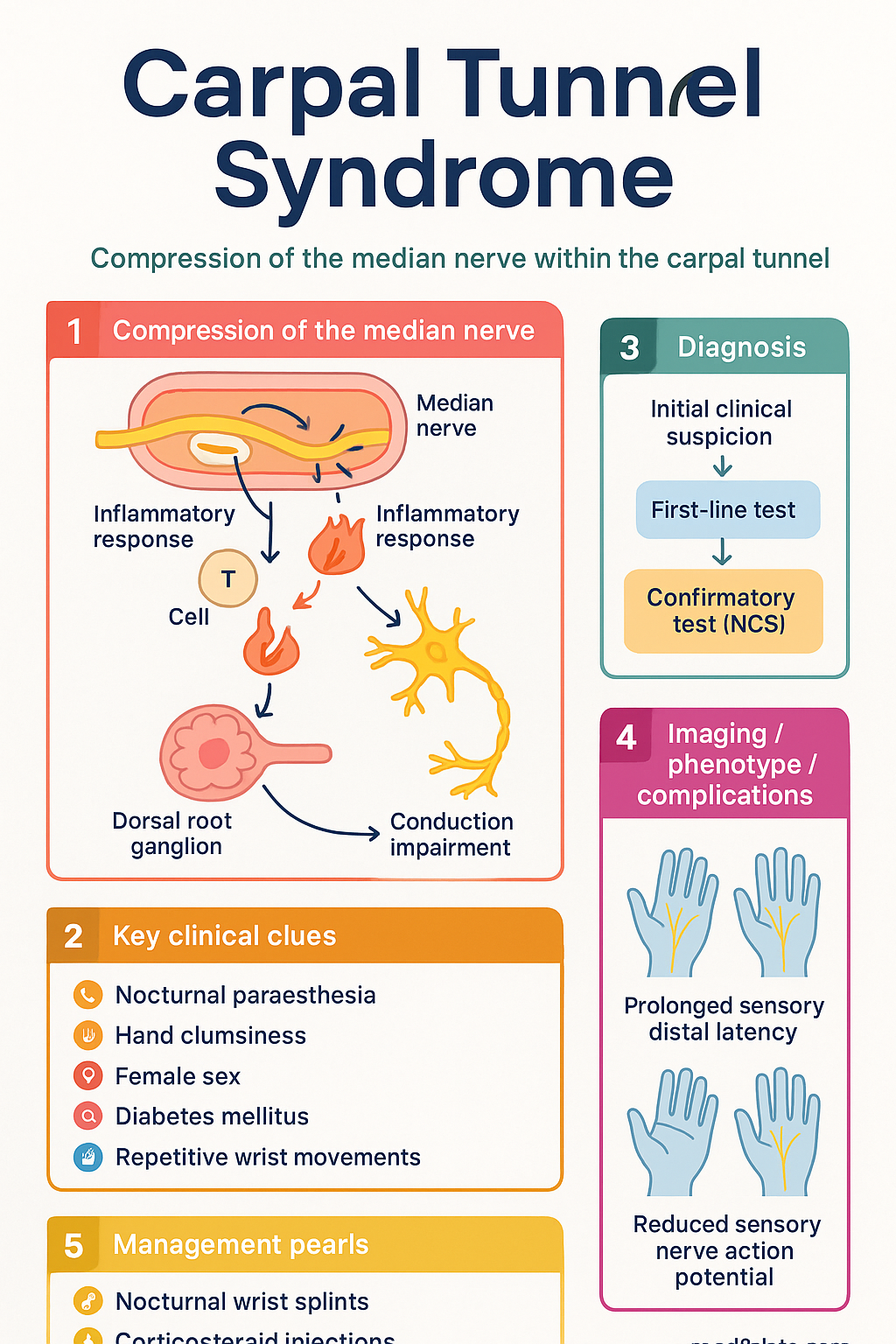
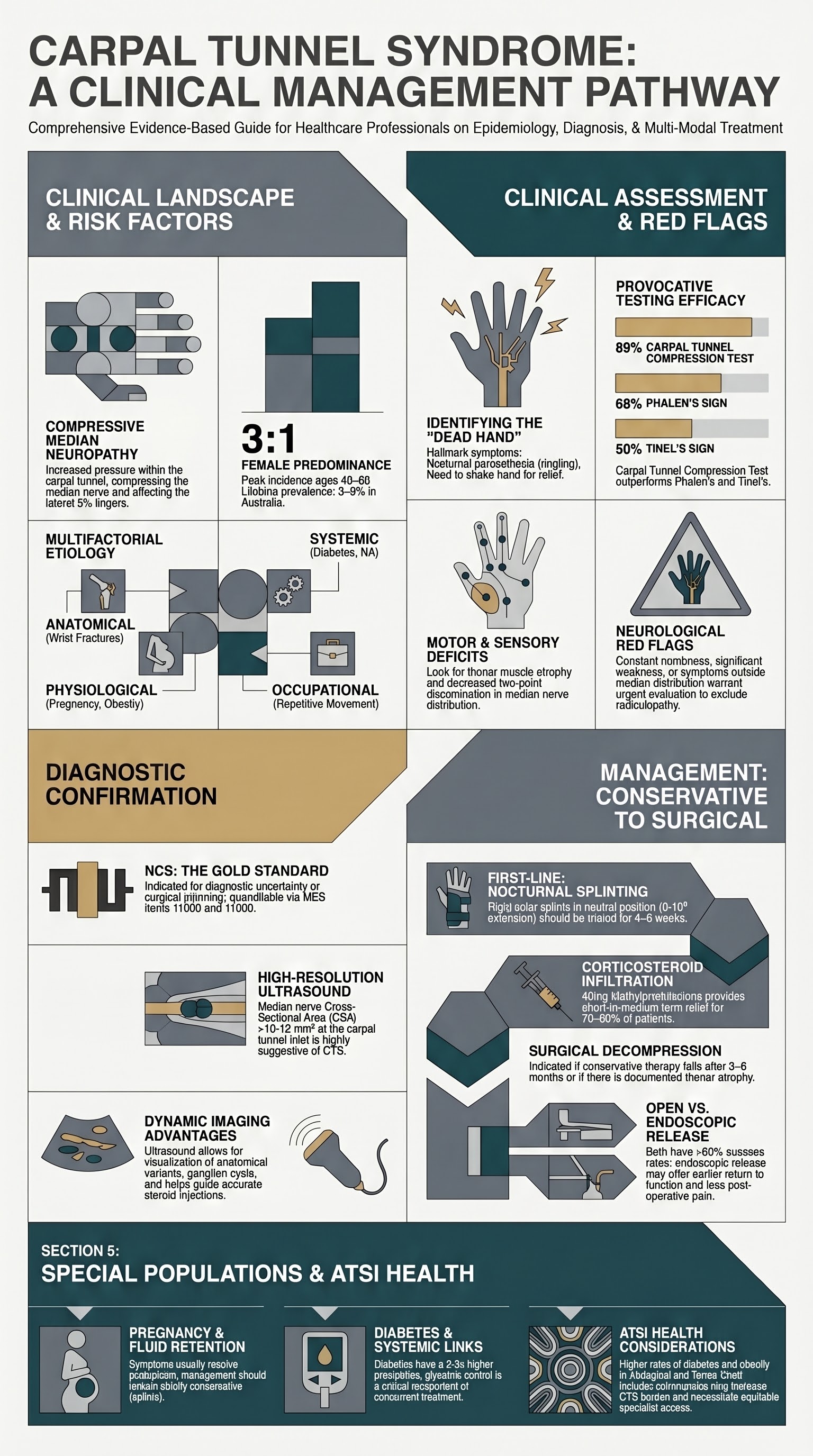
Carpal tunnel syndrome (CTS) is the most common peripheral nerve entrapment neuropathy, caused by compression of the median nerve within the carpal tunnel at the wrist. The carpal tunnel is a fibro-osseous channel bounded by the carpal bones posteriorly and the flexor retinaculum anteriorly; it contains the median nerve and nine flexor tendons. Compression produces a characteristic pattern of pain, paraesthesia, and numbness in the median nerve distribution of the hand (thumb, index, middle, and radial half of ring finger), with nocturnal symptoms being particularly characteristic. CTS affects approximately 3–5% of the general population, is more common in women, and peaks in the 40–60 age group. Australian general practice manages the majority of CTS, with corticosteroid injection and splinting as first-line treatments, and surgical carpal tunnel decompression reserved for moderate-severe or refractory cases.
| Feature | Carpal Tunnel Syndrome | Differential Diagnosis |
|---|---|---|
| Symptom distribution | Thumb, index, middle, radial ring finger (median nerve) | Cubital tunnel: little finger and ulnar ring finger; Cervical radiculopathy: dermatomal, neck pain |
| Nocturnal symptoms | Classic — waking at night with hand pain/tingling | Less characteristic in radiculopathy; cubital tunnel may have nocturnal symptoms with elbow flexion |
| Provocative tests | Phalen's test, Tinel's sign at wrist | Spurling's test for radiculopathy; Tinel's at elbow for cubital tunnel |
| Motor deficit | Thenar wasting (late); weak thumb abduction | Cubital: hypothenar/interossei wasting; radiculopathy: depends on level |
| Investigations | NCS: reduced sensory/motor velocity in median nerve at wrist | MRI spine for radiculopathy; NCS for nerve entrapment location |
Pathophysiology
Carpal tunnel syndrome results from elevated pressure within the carpal tunnel compressing the median nerve. The mechanism involves a combination of mechanical compression, ischaemia, and demyelination, with axonal degeneration in severe cases.
Anatomical and Pathological Basis
- Carpal tunnel anatomy — the tunnel is bounded by the carpal bones (floor and walls) and the flexor retinaculum (transverse carpal ligament) forming the roof; it contains the median nerve and the nine flexor tendons (four FDS, four FDP, and FPL); the ulnar nerve passes through Guyon's canal, not the carpal tunnel
- Compression mechanism — any factor increasing the volume of carpal tunnel contents or decreasing tunnel dimensions raises intracanal pressure; pressures above 20–30 mmHg impair venous return causing oedema; pressures above 40–50 mmHg impair axonal transport and produce demyelination; sustained high pressure leads to Wallerian degeneration and permanent motor and sensory deficit
- Nocturnal symptom mechanism — wrist flexion during sleep increases carpal tunnel pressure; recumbency reduces venous drainage; the characteristic nocturnal waking is due to sustained posture-related nerve ischaemia; shaking the hand (flick sign) relieves symptoms by improving circulation
- Bilateral involvement — CTS is bilateral in 50–60% of cases; bilateral simultaneous presentation should prompt investigation for systemic causes (hypothyroidism, diabetes, RA, pregnancy)
Risk Factors
- Female sex — 3:1 female to male ratio; hormonal factors and smaller carpal tunnel dimensions
- Age 40–60 years — peak incidence; increased prevalence of systemic conditions and cumulative occupational exposure
- Obesity — BMI >30 significantly increases risk; mechanism unclear but may involve increased fluid retention and soft tissue volume within tunnel
- Pregnancy — fluid retention increases carpal tunnel pressure; typically resolves postpartum; affects 20–35% of pregnant women
- Occupational factors — repetitive wrist flexion-extension, vibrating tools, and sustained awkward wrist postures; evidence for occupational CTS is moderate; computer use is a common concern but evidence is weaker than for manual tasks
- Systemic conditions — hypothyroidism (myxoedema deposits), diabetes mellitus (metabolic neuropathy increases susceptibility), rheumatoid arthritis (tenosynovitis), renal failure (dialysis amyloid), acromegaly, and thyroid disease
Clinical Presentation
The diagnosis of carpal tunnel syndrome is primarily clinical. The characteristic presentation of nocturnal hand paraesthesia in the median nerve distribution with positive Phalen's and Tinel's tests is sufficient for clinical diagnosis in most cases. Nerve conduction studies are confirmatory and required before surgical referral.
History
- Nocturnal paraesthesia — waking from sleep with pain, tingling, or numbness in the hand; affecting the thumb, index, middle, and radial half of the ring finger; patients typically describe shaking or flicking the hand to relieve symptoms (flick sign); this nocturnal pattern is the most sensitive clinical feature
- Daytime symptoms with provocative activities — sustained wrist flexion or extension (driving, holding a phone, cycling, typing); symptoms provoked by activities requiring prolonged hand grip
- Weakness and clumsiness — difficulty with pinch grip and fine manipulation (buttons, keys, jars); dropping objects; in advanced cases, permanent weakness of thenar muscles
- Pain radiation — pain may radiate proximally up the forearm and occasionally to the elbow and shoulder; this proximal radiation can be misleading but is recognised in CTS
Examination Findings
- Phalen's test — patient holds wrists in maximum flexion for 60 seconds; reproduction of paraesthesia in median nerve distribution is positive; sensitivity ~75%, specificity ~47%; most useful positive predictive value when combined with Tinel's
- Tinel's sign — percussion over the carpal tunnel (proximal wrist crease) reproduces distal tingling in median nerve distribution; sensitivity ~50%, specificity ~77%; less sensitive than Phalen's but more specific
- Thenar wasting — visible atrophy of the thenar eminence (abductor pollicis brevis, opponens pollicis) indicates advanced disease; suggests significant axonal loss and is an indication for urgent surgical referral
- Sensory testing — reduced two-point discrimination or monofilament sensation in the median nerve distribution; compare index finger to little finger; preserve sensation in the palm (palmar cutaneous branch of median nerve bypasses carpal tunnel)
Investigations
Carpal tunnel syndrome is a clinical diagnosis. Investigations are used to confirm the diagnosis before surgical referral, identify secondary causes, and exclude alternative diagnoses.
- EssentialNerve conduction studies (NCS)Gold standard for confirming CTS diagnosis before surgical referral. Demonstrates slowing of median nerve sensory and motor conduction at the wrist. Required by hand surgeons before surgical carpal tunnel decompression. Sensory NCS: prolonged distal latency (>3.5 ms); slowed conduction velocity. Motor NCS: prolonged distal latency (>4.2 ms). Severity grading guides management: mild (sensory only), moderate (sensory + motor), severe (axonal loss, thenar wasting). EMG: fibrillation and reduced recruitment in thenar muscles if axonal loss.
- EssentialTSH (thyroid stimulating hormone)Hypothyroidism is a common secondary cause of CTS; myxoedema deposits increase carpal tunnel contents. Screen all new CTS presentations. Treat hypothyroidism first — CTS may resolve with thyroid replacement therapy.
- EssentialFasting glucose or HbA1cDiabetes mellitus is strongly associated with CTS; metabolic neuropathy predisposes to nerve entrapment. Screen all CTS presentations. Uncontrolled diabetes reduces surgical outcomes.
- RecommendedMusculoskeletal ultrasoundIdentifies median nerve cross-sectional area enlargement at the carpal tunnel inlet (>10 mm² is abnormal). Useful when NCS is unavailable or equivocal. Can identify secondary causes (tenosynovitis, ganglion, anomalous muscle). Guides injection accuracy.
- SpecialisedRF, anti-CCP, ESR, CRPIf bilateral CTS without clear precipitant or other joint involvement, screen for rheumatoid arthritis. RA tenosynovitis is a cause of CTS and requires specific treatment.
Risk Stratification
Severity stratification in CTS guides management decisions and surgical urgency. The Boston Carpal Tunnel Questionnaire (BCTQ) is a validated patient-reported outcome measure. NCS severity grading correlates with appropriate management.
Pharmacological Management
Corticosteroid injection into the carpal tunnel provides effective short-to-medium term relief from CTS symptoms, with response rates of 70–80% at 1 month decreasing to 40–50% at 12 months. Oral corticosteroids and diuretics have limited evidence. Treating secondary causes is essential.
Directed Therapy
Wrist splinting is the primary non-pharmacological directed therapy for CTS. Surgical carpal tunnel decompression is indicated for moderate-severe CTS not responding to conservative management, or for severe CTS with thenar wasting.
Wrist Splint (Neutral Position)
- Design — prefabricated or custom wrist splint maintaining the wrist in neutral position (0–10 degrees extension); wrist flexion and extension both increase carpal tunnel pressure; neutral position minimises intracanal pressure; fingers and thumb should be free for use
- Evidence — night splinting reduces nocturnal paraesthesia; 50–70% improvement in symptom severity at 4 weeks; inferior to injection for sustained relief but useful adjunct; full-time splinting more effective than night-only but impairs hand function
- Duration — night splinting for 4–8 weeks; continue until symptoms resolve; can use indefinitely for mild nocturnal-only CTS without surgical need
Activity Modification
- Avoid provocative postures — avoid sustained wrist flexion (cycling, sleeping on flexed wrist, driving) and sustained repetitive grip; ergonomic keyboard and mouse positioning (neutral wrist); vibrating tool use modification
- Pregnancy-related CTS — nocturnal splinting is the primary treatment; symptoms typically resolve postpartum; injection can be used if splinting fails; surgery rarely required during pregnancy
Surgical Management
- Open or endoscopic carpal tunnel decompression — surgical division of the transverse carpal ligament (flexor retinaculum) decompresses the median nerve; performed under local anaesthesia as a day procedure; open approach is standard; endoscopic approach has equivalent outcomes with faster return to activities; both have >90% success rates for symptom relief
- Indications — failure of 2 corticosteroid injections; thenar wasting (urgent); NCS confirming axonal loss (severe); patient preference for definitive treatment over ongoing conservative management; occupational CTS with prolonged absence
- Recovery — return to light work 1–2 weeks; manual work 4–6 weeks; full sensory and motor recovery may take 3–12 months depending on degree of axonal loss; post-operative physiotherapy for scar management and grip strengthening
Non-Pharmacological Management
Non-pharmacological management of carpal tunnel syndrome centres on wrist splinting, activity modification, and treating underlying systemic causes. Patient education about the natural history and importance of splint compliance improves outcomes.
Patient Education
- Explain the mechanism — CTS is caused by nerve compression in the wrist, not a brain or spine problem; nocturnal symptoms are caused by wrist flexion during sleep; the flick sign (shaking the hand to relieve symptoms) is characteristic and reassuring
- Expected course — mild CTS often improves with splinting and treatment of secondary causes; moderate CTS has 50–60% 12-month resolution without surgery; severe CTS (thenar wasting) requires surgery to prevent permanent motor deficit
- Splint compliance — night splinting is only effective if worn consistently; patients frequently remove splints due to discomfort; trial period with education about importance of compliance; softer neoprene splints may improve adherence compared to rigid thermoplastic splints
Hand Therapy
- Nerve gliding exercises — median nerve gliding (tendon and nerve differential gliding) exercises maintain nerve mobility within the carpal tunnel; modest evidence for symptom improvement; can be taught by hand therapist or physiotherapist; 5–10 repetitions of each glide position, 3 times daily
- Occupational therapy — most useful for occupational CTS; work task analysis and ergonomic modification; functional capacity assessment for WorkCover; post-surgical hand therapy for grip strengthening and scar management
Monitoring Parameters
Monitoring in CTS tracks symptom severity, response to treatment, and identification of motor deficit. Thenar wasting is an urgent finding requiring immediate surgical referral.
| Parameter | Frequency | Action |
|---|---|---|
| Symptom severity (BCTQ or VAS) | Each consultation | No improvement at 6 weeks — consider injection; no improvement after 2 injections — NCS and surgical referral |
| Thenar muscle bulk and strength | Each consultation | New or progressive thenar wasting — urgent NCS and hand surgery referral |
| Sensory examination | Each consultation | Progressive sensory loss (two-point discrimination >6 mm) — accelerate surgical referral |
| Secondary cause screening | At diagnosis; repeat if bilateral or poor response | Untreated hypothyroidism or diabetes — treat systemic cause first; reassess CTS at 3 months |
Indications for Specialist Referral
- Thenar wasting or persistent motor weakness — urgent hand surgery referral; do not delay with further conservative management
- Failure of 2 corticosteroid injections and night splinting — hand surgery referral for NCS-confirmed surgical decompression
- Bilateral CTS without identifiable secondary cause — rheumatology review to exclude RA, inflammatory arthritis, systemic amyloid
Special Populations
Specific clinical considerations apply to pregnant patients, workers with occupational CTS, and patients with diabetes or hypothyroidism.
Pregnancy-Related CTS
- Prevalence — CTS occurs in 20–35% of pregnant women, typically in the third trimester; fluid retention increases carpal tunnel pressure; the vast majority resolve spontaneously postpartum within 3–6 months
- Management — night wrist splinting is first-line; corticosteroid injection (triamcinolone or methylprednisolone) is safe in pregnancy — small systemic absorption; use only if symptoms are severe and affecting function; avoid oral corticosteroids beyond first trimester without specialist guidance; surgery is rarely required during pregnancy
- Post-delivery course — advise expectant resolution; persistent CTS beyond 6 months postpartum should be reassessed with NCS and managed as non-pregnancy CTS
Occupational CTS
- WorkCover — occupational CTS is a compensable workplace injury; early WorkCover notification and modified duties are important; documentation of occupational exposures (vibrating tools, repetitive wrist flexion-extension) is required
- Return to work — modified duties (reduced repetitive wrist activity) within 1–2 weeks of injection; ergonomic assessment of workstation; hand surgeon coordination for surgical timing to minimise absence
Diabetes and Hypothyroidism
- Treat the systemic cause first — hypothyroidism-associated CTS frequently resolves with adequate thyroid replacement; allow 3–6 months of euthyroid state before proceeding to injection or surgery; diabetes-related CTS is more refractory and may require earlier surgical intervention
- Post-injection blood glucose monitoring — corticosteroid injection causes transient hyperglycaemia in patients with diabetes; advise monitoring for 48–72 hours post-injection; adjust insulin or oral hypoglycaemic agents if necessary
Aboriginal and Torres Strait Islander Health Considerations
Carpal tunnel syndrome in Aboriginal and Torres Strait Islander (ATSI) peoples is influenced by high rates of diabetes and obesity — both significant risk factors for CTS — as well as manual occupational exposures. Access to nerve conduction studies and surgical decompression may be limited in remote communities. Proactive screening for secondary causes is essential.
Appropriate Use of Medicine and Stewardship
Stewardship in CTS focuses on avoiding intraneural injection (a serious complication), treating secondary causes before escalating to injection or surgery, and ensuring NCS confirmation before surgical referral.
- Intraneural injection: Injecting corticosteroid directly into the median nerve causes severe neurological damage. Any resistance to injection or reproduction of sharp radiating pain indicates possible intraneural placement — withdraw immediately. Ultrasound guidance substantially reduces this risk and is strongly recommended.
- Missing secondary causes: Hypothyroidism is a common, treatable cause of CTS that is frequently overlooked. TSH should be checked at every new CTS presentation. Treating hypothyroidism may resolve CTS without injection or surgery.
- Surgical referral without NCS: Hand surgeons require nerve conduction studies before performing carpal tunnel decompression. Arrange NCS before referral to avoid referral delays and rejected referrals. NCS also provides baseline data for post-operative outcome assessment.
GP Role
- Clinical diagnosis in typical presentations — characteristic nocturnal paraesthesia in median nerve distribution with positive Phalen's and/or Tinel's is sufficient for diagnosis and initiation of conservative treatment
- Secondary cause workup — TSH and glucose/HbA1c at all new CTS presentations; RA serology if bilateral without clear precipitant
- Night splinting as first-line — prescribe neutral-position wrist splint for night use; trial for 4–8 weeks before corticosteroid injection in mild CTS
- Injection with ultrasound guidance — corticosteroid injection into the carpal tunnel; ultrasound guidance strongly recommended to avoid median nerve; arrange NCS before hand surgery referral
Follow-up and Prevention
Most mild-to-moderate CTS responds to conservative management within 3 months. Prevention focuses on ergonomic modification and treatment of systemic risk factors.
Prevention
- Ergonomic wrist positioning — maintain neutral wrist during repetitive tasks; ergonomic keyboard and mouse height; anti-vibration gloves for vibrating tool users
- Systemic risk factor control — optimal glycaemic control in diabetes; thyroid replacement therapy; weight management (obesity is a risk factor)
- Recurrence after surgery — carpal tunnel release has low recurrence rates (<5% at 5 years) with complete ligament division; incomplete release and scar formation are rare causes of recurrence
References
- 01Padua L, et al. Carpal tunnel syndrome: clinical features, diagnosis, and management. Lancet Neurol. 2016;15(12):1273–1284.
- 02Marshall S, Tardif G, Ashworth N. Local corticosteroid injection for carpal tunnel syndrome. Cochrane Database Syst Rev. 2007;(2):CD001554.
- 03Bland JDP. Carpal tunnel syndrome. BMJ. 2007;335(7615):343–346.
- 04Therapeutic Guidelines. Rheumatology. Melbourne: Therapeutic Guidelines Ltd; 2024.
- 05Pharmaceutical Benefits Scheme (PBS). Schedule of Pharmaceutical Benefits. Canberra: Department of Health; 2025.