Home Oncology Gastrointestinal Stromal Tumours (GIST)

Gastrointestinal Stromal Tumours (GIST)

📋 Key Information Summary

📋
  • Gastrointestinal Stromal Tumours (GIST) are the most common mesenchymal tumours of the gastrointestinal (GI) tract, arising from interstitial cells of Cajal.
  • Over 80% of GIST harbour activating mutations in the KIT (c-KIT) proto-oncogene; 5-10% have PDGFRA mutations. A small subset are wild-type.
  • Diagnosis relies on morphology and immunohistochemistry (IHC): CD117 (KIT) and DOG1 are the most sensitive and specific markers.
  • Risk stratification for recurrence post-resection uses the National Institutes of Health (NIH) modified criteria, incorporating mitotic rate, tumour size, and location.
  • Surgery with negative microscopic margins (R0) is the primary curative treatment for localised, resectable GIST.
  • Imatinib (Glivec®) is the cornerstone of adjuvant therapy for high-risk disease and first-line treatment for unresectable or metastatic GIST.
  • Adjuvant imatinib is typically given for 3 years for high-risk patients, based on significant overall survival benefit.
  • Mutational testing of KIT and PDGFRA is recommended for all GIST, as it predicts response to tyrosine kinase inhibitors.
  • Patients with exon 9 KIT mutations may benefit from higher dose imatinib (800 mg daily) in the metastatic setting.
  • PDGFRA D842V mutation confers primary resistance to imatinib; avapritinib is the preferred first-line agent for this genotype.
  • Multidisciplinary team (MDT) discussion at a specialist sarcoma centre is essential for all GIST management plans.
  • Aboriginal and Torres Strait Islander patients may face barriers to timely diagnosis, MDT access, and continuous therapy; culturally safe care and support are critical.

Introduction & Australian Epidemiology

Gastrointestinal Stromal Tumours (GIST) are the most common mesenchymal neoplasms of the gastrointestinal tract, thought to originate from the interstitial cells of Cajal or their precursors. They can occur anywhere along the GI tract, but most commonly arise in the stomach (60%) and small intestine (30%).

In Australia, GIST account for approximately 400-500 new diagnoses annually. The median age at diagnosis is in the sixth decade, with a slight male predominance. Most GIST are sporadic, but a small proportion (<5%) are associated with heritable syndromes such as Neurofibromatosis Type 1 (NF1) and Carney-Stratakis syndrome.
⚠️
Critical Point: GIST are distinct from other GI sarcomas (e.g., leiomyosarcoma). Accurate pathological diagnosis is mandatory as treatment paradigms differ entirely.
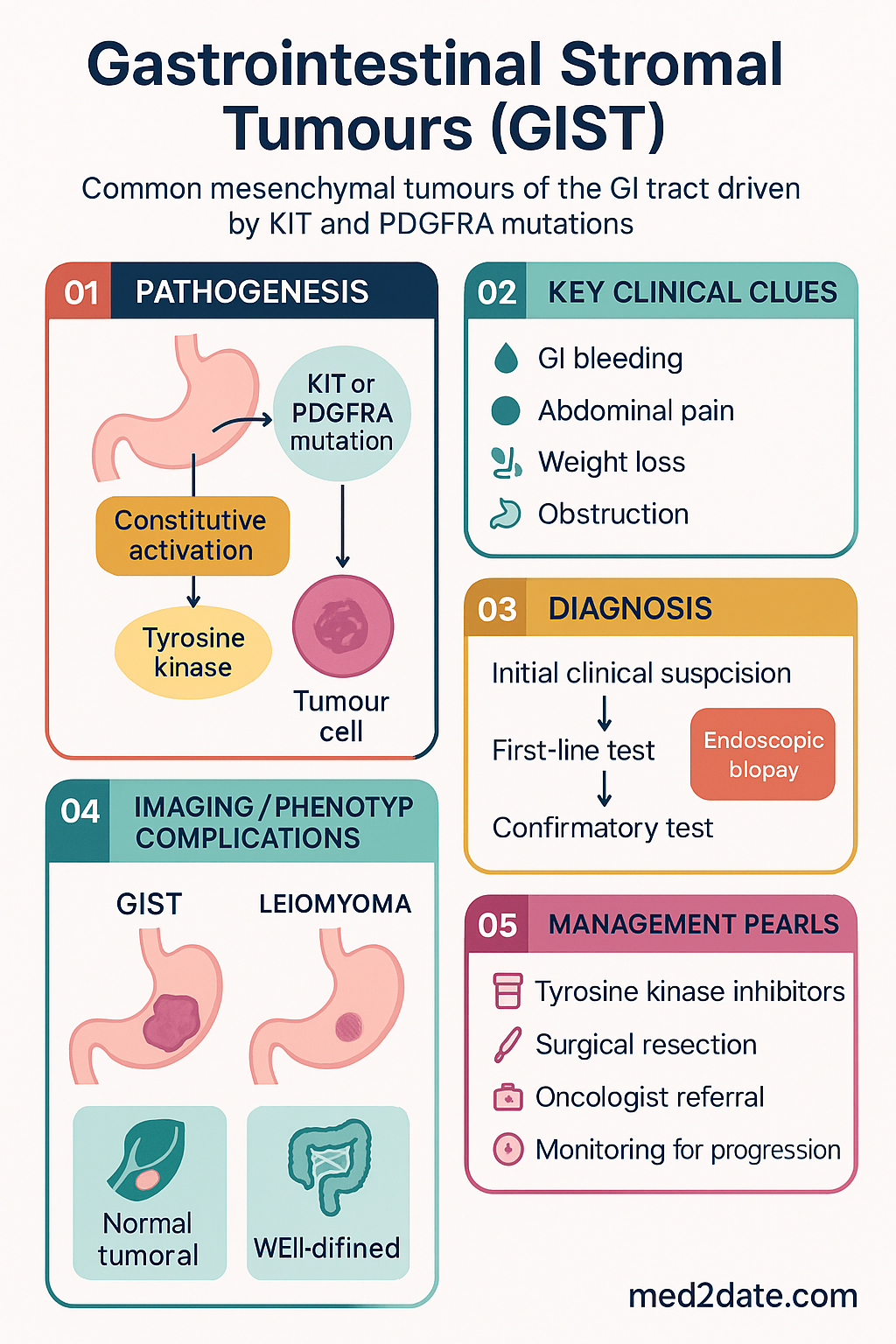
Gastrointestinal Stromal Tumours (GIST) clinical infographic — pathophysiology, clinical clues, diagnosis, imaging, and management
Tap or click image to enlarge — Gastrointestinal Stromal Tumours (GIST): pathophysiology, clinical clues, diagnosis, imaging, and management.
Gastrointestinal Stromal Tumours (GIST) infographic, full size

Pathophysiology & Mutations

GIST are driven by gain-of-function mutations in receptor tyrosine kinases, leading to constitutive activation of downstream signalling pathways (e.g., PI3K/AKT, RAS/MAPK) that promote cell proliferation and survival.

Mutation Gene Frequency Common Exons Clinical Implication
KIT ~80% 11 (juxtamembrane), 9 (extracellular) Sensitive to imatinib. Exon 9 mutations may require higher doses.
PDGFRA 5-10% 18 (D842V most common), 12 D842V mutation: primary resistance to imatinib. Sensitive to avapritinib.
Wild-type ~10-15% SDH-deficient, NF1, BRAF Generally resistant to imatinib. Require alternative approaches.

Mutational analysis is now considered standard of care in Australia for all GIST, guiding prognosis and therapy selection. It is funded via Medicare when performed at an accredited laboratory.

Diagnosis & Immunohistochemistry

Diagnosis is based on histological assessment of a biopsy or resection specimen, with ancillary immunohistochemistry (IHC) and molecular testing.

Morphology

Spindle cell (70%), epithelioid (20%), or mixed type. Accurate mitotic count (per 50 high-power fields) is critical for risk stratification.

Key IHC Markers
  • CD117 (KIT): Positive in ~95% of GIST.
  • DOG1: Highly sensitive and specific; useful in CD117-negative GIST.
  • Other markers (SMA, S-100, desmin) are typically negative but help exclude mimics.
ℹ️
MBS Item 72829: Immunohistochemical investigation of a tumour, per specimen. Ensure accurate clinical information is provided for Medicare billing.

Staging & Risk Stratification

For localised GIST, the primary goal of staging is to determine resectability and assess recurrence risk post-surgery. The AJCC/UICC TNM staging (8th edition) is used, but the modified NIH consensus criteria are more clinically useful for adjuvant therapy decisions.

Modified NIH Risk Stratification (Miettinen & Lasota)

Risk Category Tumour Size (cm) Mitotic Rate (per 50 HPF) Tumour Site
Very Low < 2.0 < 5 Any
Low 2.1 - 5.0 < 5 Any
Intermediate < 5.0 6 - 10 Gastric
5.1 - 10.0 < 5 Gastric
High > 5.0 > 5 Any
> 10.0 Any Any
Any > 10 Any
> 2.0 > 5 Non-gastric

Imaging: Staging CT (chest/abdomen/pelvis) is standard. PET-CT (MBS Item 61506, Authority Required) may be used for assessing response to imatinib or ambiguous CT findings.

Management (Surgery & Imatinib)

Surgery for Localised Disease

The goal is complete gross resection (R0) without tumour rupture. Lymphadenectomy is not required as nodal metastases are rare. Laparoscopic resection is acceptable for small gastric GIST.

🚨
Avoid Tumour Rupture: Intraoperative tumour rupture converts the patient to a very high-risk category and mandates adjuvant imatinib. Careful surgical technique is paramount.

Adjuvant Imatinib Therapy

Indicated for patients at significant risk of recurrence.

💊
Imatinib
Glivec® · Generic available · Tyrosine Kinase Inhibitor
Adult dose (adjuvant) 400 mg orally once daily
Duration 3 years for high-risk (based on SSG XVIII trial data)
Key monitoring FBC, LFTs, renal function at baseline and regularly. Watch for oedema, rash, myalgia.
PBS status ✔ PBS Authority Required (Requires approval via PBS online for adjuvant/advanced GIST)

Advanced / Metastatic Disease

Imatinib 400 mg daily is first-line. For exon 9 KIT mutations, 800 mg daily may be considered. Regular imaging (CT 3-6 monthly) assesses response.

1st-line
Imatinib 400 mg daily. Continue until progression or intolerance.
2nd-line
Sunitinib (Sutent®) 50 mg daily (4 weeks on, 2 weeks off) or 37.5 mg continuous daily dose.
3rd-line
Regorafenib (Stivarga®) 160 mg daily (3 weeks on, 1 week off).
4th-line+
Ripretinib (Qinlock®) 150 mg daily. (Check PBS listing status).
PDGFRA D842V Mutation: First-line therapy is avapritinib (Ayvakit®) 300 mg daily, not imatinib. It is PBS listed for this specific genotype.

Special Populations

🤰 Pregnancy
Imatinib
Contraindicated in pregnancy (teratogenic). Effective contraception is mandatory during and for 3 months after therapy. Pregnancy should be planned in consultation with MDT.
🧪 Renal Impairment
Imatinib
Use with caution. No dose adjustment for mild-moderate impairment (eGFR 20-59). Limited data in severe impairment (eGFR <20). Monitor closely.
🫁 Hepatic Impairment
Imatinib
Metabolised hepatically. Reduce dose by 25% in mild-moderate impairment (Child-Pugh A/B). Avoid in severe impairment (Child-Pugh C) or use with extreme caution.
🛡️ Immunocompromised
Imatinib
Not immunosuppressive in the conventional sense. No specific increased infection risk beyond that of the underlying condition.

Aboriginal and Torres Strait Islander Health Considerations

Aboriginal and Torres Strait Islander Health

While specific data on GIST incidence in Aboriginal and Torres Strait Islander populations is limited, broader inequities in cancer outcomes are well documented. A culturally safe approach is essential.

Access & Timeliness
Barriers to accessing specialist sarcoma MDTs, particularly for patients in regional and remote Australia. Support from local Indigenous Health Workers and telehealth links are vital.
Treatment Adherence
Supporting continuous adherence to long-term oral imatinib requires addressing practical barriers (cost, travel for prescriptions, health literacy) and holistic, family-centred care.
Cultural Safety
Diagnosis and management discussions should involve family/kin as desired by the patient. Liaise with local Aboriginal and Torres Strait Islander health services to provide coordinated, wrap-around support.

📚 References

  1. 1. Casali PG, Blay JY, Abecassis N, et al. Gastrointestinal stromal tumours: ESMO-EURACAN-GENTURIS Clinical Practice Guidelines for diagnosis, treatment and follow-up. Ann Oncol. 2022;33(1):20-33.
  2. 2. National Comprehensive Cancer Network (NCCN). NCCN Clinical Practice Guidelines in Oncology: Soft Tissue Sarcoma. Version 2.2024.
  3. 3. Joensuu H, Eriksson M, Sundby Hall K, et al. Survival outcomes associated with 3 years vs 1 year of adjuvant imatinib for patients with high-risk gastrointestinal stromal tumors: an analysis of a randomized clinical trial after 10-year follow-up. JAMA Oncol. 2020;6(8):1241-1246.
  4. 4. Miettinen M, Lasota J. Gastrointestinal stromal tumors: review on morphology, molecular pathology, prognosis, and differential diagnosis. Arch Pathol Lab Med. 2006;130(10):1466-1478.
  5. 5. Blay JY, Kang YK, Nishida T, et al. Gastrointestinal stromal tumours. Nat Rev Dis Primers. 2021;7(1):22.
  6. 6. Cancer Council Australia Sarcoma Guidelines Working Party. Clinical practice guidelines for the management of sarcoma. Cancer Council Australia, Sydney. 2023.
  7. 7. Australian Institute of Health and Welfare (AIHW). Cancer in Aboriginal & Torres Strait Islander people of Australia. Cat. no. CAN 118. Canberra: AIHW. 2023.
  8. 8. Reichardt P, Blay JY, Boukovinas I, et al. Adjuvant treatment of GIST with imatinib: solid ground or still quicksand? A comment on behalf of the EORTC Soft Tissue and Bone Sarcoma Group, the Italian Sarcoma Group, the NCRI Sarcoma Clinical Studies Group (UK), the Japanese Study Group on GIST, the French Sarcoma Group, and the Spanish Group for Research on Sarcomas (GEIS). Eur J Cancer. 2009;45(1):11-14.
  9. 9. Demetri GD, von Mehren M, Blanke CD, et al. Efficacy and safety of imatinib mesylate in advanced gastrointestinal stromal tumors. N Engl J Med. 2002;347(7):472-480.
  10. 10. Therapeutic Goods Administration (TGA). Australian Public Assessment Report for Imatinib (as mesylate). Department of Health, Australian Government. 2022.
  11. 11. National Health and Medical Research Council (NHMRC). National Statement on Ethical Conduct in Human Research 2023 (Updated 2024). Canberra: NHMRC.
for PBS-listed medicines at participating pharmacies.
Cultural safety
Engagement with Aboriginal Community Controlled Health Organisations (ACCHOs) is essential. Cultural safety training for non-Indigenous clinicians, use of Aboriginal Health Workers and Liaison Officers, and incorporation of traditional healing practices alongside Western medicine improve treatment adherence and outcomes. Avoidance of eye contact, respect for gender-sensitive examination practices, and understanding of sorry business protocols are critical elements of culturally safe care.
Medication adherence
Complex DMARD regimens with frequent monitoring requirements present adherence challenges. Long-acting depot injections (e.g., methotrexate SC) may improve adherence compared to oral regimens. Community pharmacy partnerships through the Indigenous Pharmacy Programmes improve medication management.
Specific conditions
Rheumatic heart disease (RHD) requires secondary prophylaxis with benzathine penicillin G (BPG) 1.2 MU IM every 3–4 weeks for a minimum of 10 years or until age 21 (whichever is longer). RHD registers (e.g., NT RHD Register) facilitate recall and follow-up. The Australian RHD Endgame Strategy targets elimination by 2031.
Referral pathways
Referral through ACCHOs and Aboriginal Hospital Liaison Officers (AHLOs) improves engagement. The Specialist Outreach Assistance Programme provides funded specialist visits to remote communities. NT, WA, and QLD have specific rheumatology outreach programmes targeting Indigenous communities.

📚 References

  1. 1. Australian Institute of Health and Welfare (AIHW). Autoimmune disease in Australia. Cat. no. PHE 312. Canberra: AIHW; 2023.
  2. 2. Fraenkel L, Bathon JM, England BR, et al. 2021 American College of Rheumatology guideline for the treatment of rheumatoid arthritis. Arthritis Care Res. 2021;73(7):924–939.
  3. 3. Fanouriakis A, Kostopoulou M, Alber K, et al. 2019 update of the EULAR recommendations for the management of systemic lupus erythematosus. Ann Rheum Dis. 2019;78(6):736–745.
  4. 4. Chung SA, Langford CA, Maz M, et al. 2021 American College of Rheumatology/Vasculitis Foundation guideline for the management of antineutrophil cytoplasmic antibody-associated vasculitis. Arthritis Care Res. 2021;73(11):1583–1599.
  5. 5. Smolen JS, Landewé RBM, Bijlsma JWJ, et al. EULAR recommendations for the management of rheumatoid arthritis with synthetic and biological disease-modifying antirheumatic drugs: 2022 update. Ann Rheum Dis. 2023;82(1):3–18.
  6. 6. Australian Technical Advisory Group on Immunisation (ATAGI). Australian Immunisation Handbook. Australian Government Department of Health; 2024. Available from: immunisationhandbook.health.gov.au.
  7. 7. Rheumatic Heart Disease Australia (RHDAustralia). The 2020 Australian guideline for prevention, diagnosis, and management of acute rheumatic fever and rheumatic heart disease. 3rd ed. Darwin: Menzies School of Health Research; 2020.
  8. 8. Pharmaceutical Benefits Scheme (PBS). PBS Schedule. Australian Government Department of Health. Available from: pbs.gov.au. Accessed 2024.
  9. 9. Agarwal S, Cunnington J, Nossent J. Autoimmune disease in Indigenous Australians: a systematic review. Int J Rheum Dis. 2021;24(12):1487–1498.
  10. 10. Pisetsky DS. Antinuclear antibody testing — misunderstood or misused? Clin Immunol. 2023;255:109717.
  11. 11. Bertsias GK, Tektonidou M, Amoura Z, et al. Joint European League Against Rheumatism and European Renal Association–European Dialysis and Transplant Association (EULAR/ERA-EDTA) recommendations for the management of adult and paediatric lupus nephritis. Ann Rheum Dis. 2012;71(11):1771–1782.
  12. 12. Ledingham J, Deighton C; British Society for Rheumatology Standards, Audit and Guidelines Working Group. Update on the British Society for Rheumatology guidelines for prescribing TNFα blockers in adults with rheumatoid arthritis. Rheumatology. 2005;44(2):155–158.
  13. 13. National Health and Medical Research Council (NHMRC). National statement on ethical conduct in human research. Canberra: NHMRC; 2023 (updated).
for PBS-listed medicines at participating pharmacies.
Cultural safety
Engagement with Aboriginal Community Controlled Health Organisations (ACCHOs) is essential. Cultural safety training for non-Indigenous clinicians, use of Aboriginal Health Workers and Liaison Officers, and incorporation of traditional healing practices alongside Western medicine improve treatment adherence and outcomes. Avoidance of eye contact, respect for gender-sensitive examination practices, and understanding of sorry business protocols are critical elements of culturally safe care.
Medication adherence
Complex DMARD regimens with frequent monitoring requirements present adherence challenges. Long-acting depot injections (e.g., methotrexate SC) may improve adherence compared to oral regimens. Community pharmacy partnerships through the Indigenous Pharmacy Programmes improve medication management.
Specific conditions
Rheumatic heart disease (RHD) requires secondary prophylaxis with benzathine penicillin G (BPG) 1.2 MU IM every 3–4 weeks for a minimum of 10 years or until age 21 (whichever is longer). RHD registers (e.g., NT RHD Register) facilitate recall and follow-up. The Australian RHD Endgame Strategy targets elimination by 2031.
Referral pathways
Referral through ACCHOs and Aboriginal Hospital Liaison Officers (AHLOs) improves engagement. The Specialist Outreach Assistance Programme provides funded specialist visits to remote communities. NT, WA, and QLD have specific rheumatology outreach programmes targeting Indigenous communities.

📚 References

  1. 1. Australian Institute of Health and Welfare (AIHW). Autoimmune disease in Australia. Cat. no. PHE 312. Canberra: AIHW; 2023.
  2. 2. Fraenkel L, Bathon JM, England BR, et al. 2021 American College of Rheumatology guideline for the treatment of rheumatoid arthritis. Arthritis Care Res. 2021;73(7):924–939.
  3. 3. Fanouriakis A, Kostopoulou M, Alber K, et al. 2019 update of the EULAR recommendations for the management of systemic lupus erythematosus. Ann Rheum Dis. 2019;78(6):736–745.
  4. 4. Chung SA, Langford CA, Maz M, et al. 2021 American College of Rheumatology/Vasculitis Foundation guideline for the management of antineutrophil cytoplasmic antibody-associated vasculitis. Arthritis Care Res. 2021;73(11):1583–1599.
  5. 5. Smolen JS, Landewé RBM, Bijlsma JWJ, et al. EULAR recommendations for the management of rheumatoid arthritis with synthetic and biological disease-modifying antirheumatic drugs: 2022 update. Ann Rheum Dis. 2023;82(1):3–18.
  6. 6. Australian Technical Advisory Group on Immunisation (ATAGI). Australian Immunisation Handbook. Australian Government Department of Health; 2024. Available from: immunisationhandbook.health.gov.au.
  7. 7. Rheumatic Heart Disease Australia (RHDAustralia). The 2020 Australian guideline for prevention, diagnosis, and management of acute rheumatic fever and rheumatic heart disease. 3rd ed. Darwin: Menzies School of Health Research; 2020.
  8. 8. Pharmaceutical Benefits Scheme (PBS). PBS Schedule. Australian Government Department of Health. Available from: pbs.gov.au. Accessed 2024.
  9. 9. Agarwal S, Cunnington J, Nossent J. Autoimmune disease in Indigenous Australians: a systematic review. Int J Rheum Dis. 2021;24(12):1487–1498.
  10. 10. Pisetsky DS. Antinuclear antibody testing — misunderstood or misused? Clin Immunol. 2023;255:109717.
  11. 11. Bertsias GK, Tektonidou M, Amoura Z, et al. Joint European League Against Rheumatism and European Renal Association–European Dialysis and Transplant Association (EULAR/ERA-EDTA) recommendations for the management of adult and paediatric lupus nephritis. Ann Rheum Dis. 2012;71(11):1771–1782.
  12. 12. Ledingham J, Deighton C; British Society for Rheumatology Standards, Audit and Guidelines Working Group. Update on the British Society for Rheumatology guidelines for prescribing TNFα blockers in adults with rheumatoid arthritis. Rheumatology. 2005;44(2):155–158.
  13. 13. National Health and Medical Research Council (NHMRC). National statement on ethical conduct in human research. Canberra: NHMRC; 2023 (updated).