📋 Key Information Summary
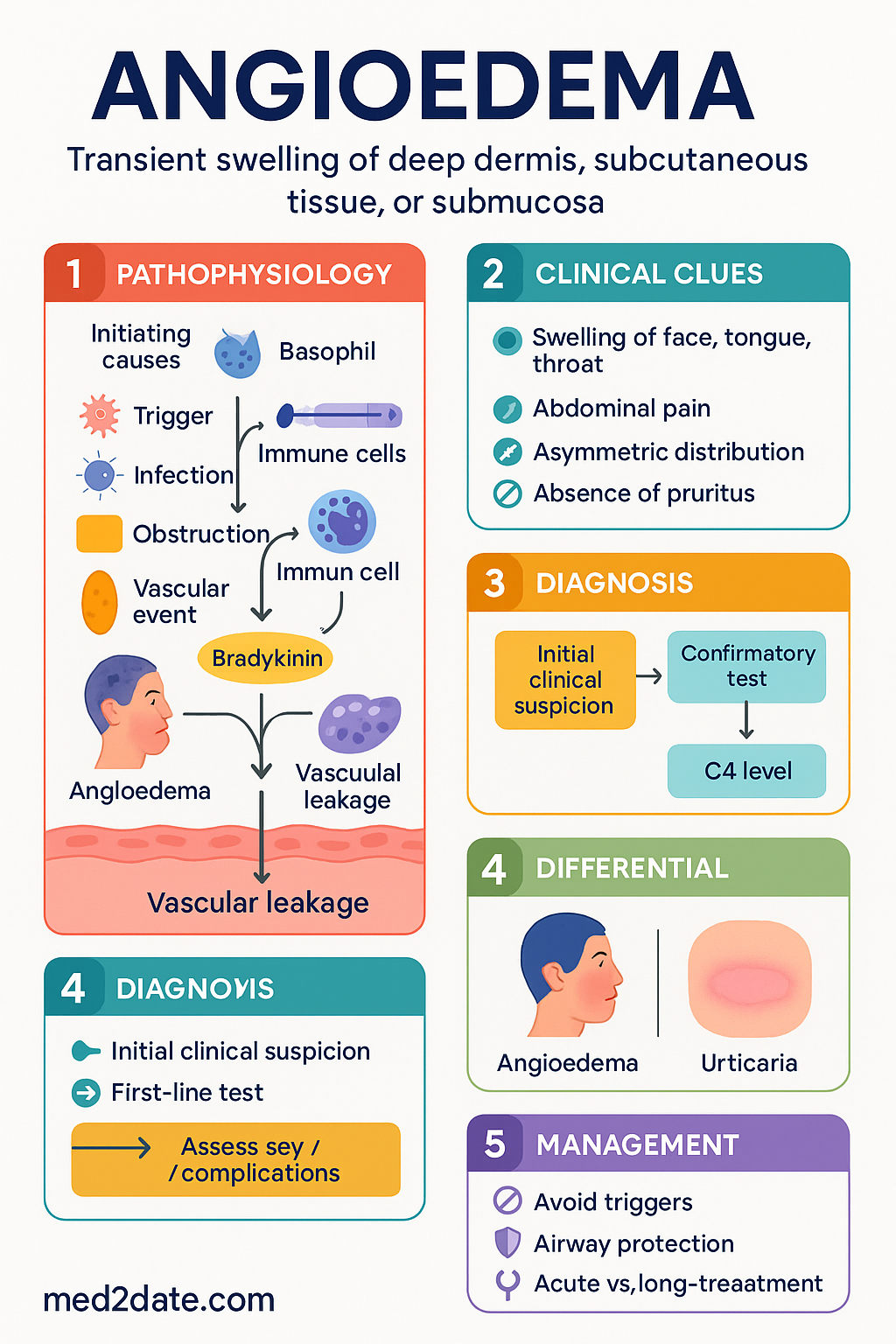
- Angioedema is transient, localised swelling of deep dermis, subcutaneous tissue, or submucosa; laryngeal involvement is a medical emergency with risk of fatal asphyxiation.
- Two principal pathophysiological pathways: histamine-mediated (allergic / mast-cell) and bradykinin-mediated (hereditary angioedema, ACE-inhibitor induced).
- Histamine-mediated angioedema typically responds to adrenaline, H₁-antihistamines, and corticosteroids; bradykinin-mediated angioedema does not — misdiagnosis delays effective treatment.
- Hereditary angioedema (HAE) is caused by C1-inhibitor deficiency (Type I ~85 %, Type II ~15 %); Type III (normal C1-INH) is rarer and often factor-XII mutation–related.
- ACE-inhibitor angioedema accounts for 20–40 % of emergency angioedema presentations in Australia; onset may occur months to years after commencing therapy.
- First-episode or diagnostic uncertainty requires C4 level as screening test — if low, proceed to C1-inhibitor quantitative and functional assays.
- Emergency airway management takes precedence; early anaesthetic/ENT review if any stridor, voice change, or tongue swelling.
- For histamine-mediated attacks: adrenaline 0.01 mg/kg IM (max 0.5 mg), IV dexchlorpheniramine or promethazine, hydrocortisone IV.
- For HAE acute attacks: C1-inhibitor concentrate (Berinert®) IV or icatibant (Firazyr®) SC — both available through special-access pathways in Australia.
- ACE inhibitors must be permanently discontinued after an angioedema episode; switch to ARB or alternative with monitoring.
- All patients with confirmed HAE should carry a personalised action plan and medical-alert identification; consider long-term prophylaxis with danazol, tranexamic acid, or subcutaneous C1-INH (Haegarda®).
- Aboriginal and Torres Strait Islander peoples may face delayed presentation due to geographic remoteness; ensure culturally safe follow-up and access to adrenaline autoinjectors.
Introduction & Australian Epidemiology
Angioedema is characterised by transient, localised subcutaneous or submucosal swelling resulting from increased vascular permeability in deep tissue layers. Unlike urticaria, which affects superficial dermis, angioedema involves deeper structures and presents with non-pitting, asymmetrical swelling — most commonly of the lips, tongue, periorbital region, and extremities. Involvement of the upper airway constitutes a life-threatening emergency that demands immediate recognition and intervention.
In Australia, angioedema accounts for an estimated 1 in 500 emergency department (ED) presentations annually, with hospital admission rates for angioedema rising by approximately 2–3 % per year over the past decade. The increasing prevalence is attributed in part to widespread ACE-inhibitor prescribing — ACE inhibitors are among the most commonly dispensed medications on the Pharmaceutical Benefits Scheme (PBS), and ACE-inhibitor angioedema now represents 20–40 % of all angioedema ED presentations nationally.
Hereditary angioedema (HAE) is rare, with an estimated prevalence of 1 in 50,000 Australians; however, significant diagnostic delay (averaging 8–10 years from first symptom to diagnosis) suggests under-recognition. The Australian HAE patient registry data indicate that patients experience a mean of 4–6 attacks per year before commencing prophylaxis, with laryngeal involvement reported in up to 50 % of patients over their lifetime.
This guideline covers the classification, pathophysiology, diagnosis, and emergency management of angioedema in the Australian clinical context, with attention to PBS-listed therapies, state-based hospital protocols, and equity considerations for underserved populations.
Types of Angioedema
Accurate classification is essential because histamine-mediated and bradykinin-mediated angioedema require fundamentally different treatments. The major types encountered in Australian practice are summarised below.
| Type | Mechanism | Common Triggers / Associations | Responds to Adrenaline / Antihistamines? |
|---|---|---|---|
| Allergic (histamine-mediated) | IgE-mediated mast-cell degranulation → histamine release | Foods (peanut, shellfish, egg), NSAIDs, latex, insect stings, antibiotics (penicillin) | Yes — first-line |
| Hereditary angioedema (HAE) Type I | Quantitative C1-inhibitor deficiency → unregulated kallikrein → excess bradykinin | Trauma, stress, dental procedures, OCP/oestrogens; often spontaneous | No |
| HAE Type II | Dysfunctional C1-inhibitor (normal or elevated levels, reduced function) | Same as Type I | No |
| HAE Type III (normal C1-INH) | Often factor-XII gain-of-function mutation; oestrogen-sensitive | Oestrogen-containing contraceptives, pregnancy | No |
| ACE-inhibitor angioedema | Bradykinin accumulation due to reduced degradation (ACE = kininase II) | Enalapril, ramipril, perindopril — may occur months–years after initiation | No |
| Acquired C1-inhibitor deficiency | Autoantibody consumption of C1-INH; associated with lymphoproliferative disorders | B-cell lymphoma, monoclonal gammopathy | No |
| Idiopathic | Unknown; may be histamine-mediated or bradykinin-mediated | Diagnosis of exclusion | Variable |
Pathophysiology
Histamine-Mediated (Allergic) Pathway
Allergen cross-links surface-bound IgE on mast cells and basophils, triggering degranulation and release of histamine, tryptase, prostaglandins, and leukotrienes. Histamine acts on H₁-receptors on vascular endothelial cells, causing endothelial cell contraction, intercellular gap formation, and plasma extravasation into the deep dermis and submucosa. The result is non-pitting oedema that is typically pruritic, often accompanied by urticaria, and resolves within 24–72 hours.
Bradykinin-Mediated Pathway
Bradykinin is a potent vasoactive nonapeptide generated by the action of kallikrein on high-molecular-weight kininogen (HMWK). C1-inhibitor (C1-INH) is the primary regulatory serine protease inhibitor (serpin) of this pathway — it inhibits activated factor XII (Hageman factor), plasma kallikrein, and C1s/C1r in the classical complement pathway.
In HAE Type I (~85 % of cases), reduced synthesis of C1-INH protein leads to uninhibited kallikrein activity and excess bradykinin production. In Type II (~15 %), C1-INH protein levels are normal or elevated but the molecule is dysfunctional. In both types, C4 is chronically low because of unregulated classical-pathway consumption.
ACE-inhibitor angioedema occurs because angiotensin-converting enzyme (ACE) is identical to kininase II — the primary enzyme responsible for bradykinin degradation. Inhibition of ACE raises local bradykinin concentrations, predisposing to angioedema. Individual susceptibility likely depends on polymorphisms in aminopeptidase P and neprilysin (alternative bradykinin-degradation pathways).
Clinical Features & Diagnosis
Clinical Presentation
Angioedema presents with recurrent episodes of localised, non-pitting oedema affecting one or more of the following sites:
- Face: Lips, periorbital region, cheeks — the most common site overall
- Upper airway: Tongue, uvula, soft palate, larynx — potentially fatal; 25–50 % of HAE patients experience at least one laryngeal attack
- Extremities: Hands, feet — can be debilitating and interfere with daily function
- Gastrointestinal tract: Colicky abdominal pain, nausea, vomiting, diarrhoea — due to bowel-wall oedema; may mimic an acute abdomen
- Urogenital: Genital swelling (more common in HAE)
Differentiating Histamine-Mediated from Bradykinin-Mediated Angioedema
| Feature | Histamine-Mediated | Bradykinin-Mediated (HAE / ACE-I) |
|---|---|---|
| Urticaria | Usually present (≥ 90 %) | Absent |
| Pruritus | Prominent | Usually absent; may have tingling / tightness |
| Prodrome | None or sudden onset | Tingling, erythema marginatum (serpiginous, non-pruritic rash) in ~40 % of HAE |
| Onset to peak | Minutes to 1–2 hours | Gradual over 12–36 hours; untreated lasts 2–5 days |
| Response to adrenaline | Rapid improvement | Poor or absent |
| Family history | Atopy | Autosomal dominant (50 %); 25 % are de-novo mutations |
| Medications | NSAIDs, antibiotics | ACE inhibitors, oestrogens |
Diagnostic Approach
The diagnostic algorithm depends on clinical context:
Investigations with Australian Availability
Emergency Management
Immediate Resuscitation (All Angioedema Types)
Histamine-Mediated (Allergic) Angioedema — Acute Treatment
Bradykinin-Mediated Angioedema (HAE) — Acute Treatment
Standard allergy therapies (adrenaline, antihistamines, corticosteroids) are not effective for bradykinin-mediated attacks. Targeted therapies are required and should be administered as early as possible.
ACE-Inhibitor Angioedema — Management
If the attack is bradykinin-mediated and targeted HAE therapies are available, consider icatibant or C1-INH concentrate under specialist guidance. Evidence is emerging but not yet definitive. Icatibant has shown benefit in small RCTs for ACE-inhibitor angioedema.
For ACE-inhibitor angioedema with airway compromise that is not responding to standard measures, discuss with the on-call immunologist or contact the Australian HAE Helpline (through HAE Australasia) for advice on emergency access to C1-INH concentrate.
Observation & Disposition
Long-Term Prophylaxis for HAE
Long-term prophylaxis (LTP) is indicated for patients with ≥ 1 attack per month, significant disease burden, laryngeal attack history, or limited access to on-demand therapy. Options available in Australia:
Special Populations
Aboriginal and Torres Strait Islander Health Considerations
📚 References
- 1. Maurer M, Magerl M, Ansotegui I, et al. The international WAO/EAACI guideline for the management of hereditary angioedema — the 2021 revision and update. World Allergy Organ J. 2022;15(1):100627.
- 2. Betschel S, Badiou J, Binkley K, et al. The International/Canadian Hereditary Angioedema Guideline. Allergy Asthma Clin Immunol. 2019;15:72.
- 3. Australasian Society of Clinical Immunology and Allergy (ASCIA). ASCIA guidelines for prevention of anaphylaxis in schools, preschools and childcare. Sydney: ASCIA; 2023.
- 4. Cicardi M, Aberer W, Banerji A, et al. Classification, diagnosis, and approach to treatment for angioedema: consensus report from the Hereditary Angioedema International Working Group. Allergy. 2014;69(5):602–616.
- 5. Bernstein JA, Cremonesi A, Hoffmann TK, Hollingsworth J. Angioedema in the emergency department: a practical guide to differential diagnosis and management. Int J Emerg Med. 2017;10(1):15.
- 6. Banerji A, Clark S, Bland K, et al. ACE-inhibitor angioedema in the emergency department: clinical characteristics, management, and outcomes. J Allergy Clin Immunol Pract. 2020;8(10):3385–3392.
- 7. Pharmaceutical Benefits Scheme (PBS). Australian Government Department of Health. Available at: https://www.pbs.gov.au. Accessed June 2025.
- 8. Australian Commission on Safety and Quality in Health Care (ACSQHC). National Safety and Quality Health Service Standards. 2nd ed. Sydney: ACSQHC; 2021.
- 9. Australian Institute of Health and Welfare (AIHW). Allergic disease in Australia. Cat. no. ACM 35. Canberra: AIHW; 2023.
- 10. HAE Australasia. Living with hereditary angioedema in Australia and New Zealand. Patient registry report. Sydney: HAE Australasia; 2023.
- 11. Frank MM, Gelfand JA, Atkinson JP. Hereditary angioedema: the clinical syndrome and its management. Ann Intern Med. 1976;84(5):580–593.
- 12. RHDAustralia (Northern Territory Department of Health and Menzies School of Health Research). The Australian guidelines for prevention, diagnosis and management of acute rheumatic fever and rheumatic heart disease. 3rd ed. Darwin: RHDAustralia; 2020. [Referenced for ATSI health frameworks applicable across clinical guidelines.]
- 13. Sinert R, Levy P, Bernstein JA, et al. Randomized trial of icatibant for ACE-inhibitor-induced angioedema in the emergency department. Ann Emerg Med. 2017;69(4):389–397.
- 14. Lumry WR, Li HH, Levy RJ, et al. Randomized placebo-controlled trial of the bradykinin B₂ receptor antagonist icatibant for the treatment of acute attacks of hereditary angioedema: the FAST-3 trial. Ann Allergy Asthma Immunol. 2011;107(6):529–537.
- 15. The Australasian Society of Clinical Immunology and Allergy (ASCIA). Position statement — prevention of anaphylaxis. Sydney: ASCIA; 2024.