Home Oncology Colorectal Cancer

Colorectal Cancer

📋 Key Information Summary

📋
  • Colorectal cancer (CRC) is the third most commonly diagnosed cancer and the second leading cause of cancer-related death in Australia.
  • Over 95% are adenocarcinomas, arising from the malignant transformation of adenomatous polyps over 10–15 years.
  • Key modifiable risk factors include high consumption of red/processed meat, obesity, smoking, and excessive alcohol intake.
  • Non-modifiable risk factors include age >50, inflammatory bowel disease (IBD), and inherited syndromes like Lynch syndrome (HNPCC) and Familial Adenomatous Polyposis (FAP).
  • The Australian National Bowel Cancer Screening Program (NBCSP) uses immunochemical faecal occult blood testing (iFOBT) for population screening from age 50.
  • Diagnosis is confirmed by colonoscopy and histological biopsy. Essential staging investigations include CT chest/abdomen/pelvis and MRI pelvis for rectal cancer.
  • Treatment is stage-dependent and guided by multidisciplinary team (MDT) discussion. Surgery is the primary curative treatment for localised disease.
  • For locally advanced rectal cancer, neoadjuvant chemoradiotherapy (e.g., 5-FU/capecitabine + radiation) is standard to improve resectability and local control.
  • Adjuvant chemotherapy (e.g., FOLFOX, CapeOx) is indicated for stage III and high-risk stage II colon cancer.
  • For metastatic disease, treatment intent (curative vs. palliative) and RAS/BRAF mutation status guide the use of targeted agents like cetuximab, bevacizumab, and encorafenib.
  • Aboriginal and Torres Strait Islander peoples have higher CRC incidence and mortality, with later presentation and greater barriers to optimal care.

Introduction & Australian Epidemiology

Colorectal cancer (CRC) encompasses malignancies of the colon and rectum. It is a major cause of cancer morbidity and mortality in Australia, with a lifetime risk of approximately 1 in 13 for both sexes. The disease typically arises through the adenoma-carcinoma sequence, a stepwise progression from normal epithelium to adenomatous polyp to invasive carcinoma, driven by the accumulation of genetic and epigenetic alterations.

In Australia, CRC is the third most common cancer (excluding non-melanoma skin cancers) and the second most common cause of cancer death. According to the Australian Institute of Health and Welfare (AIHW), an estimated 15,500 new cases are diagnosed annually. Incidence increases sharply with age, with the majority of cases diagnosed in those over 50. Mortality rates have been gradually declining due to screening, improved treatments, and earlier detection. Significant disparities exist, with Aboriginal and Torres Strait Islander peoples experiencing poorer outcomes.
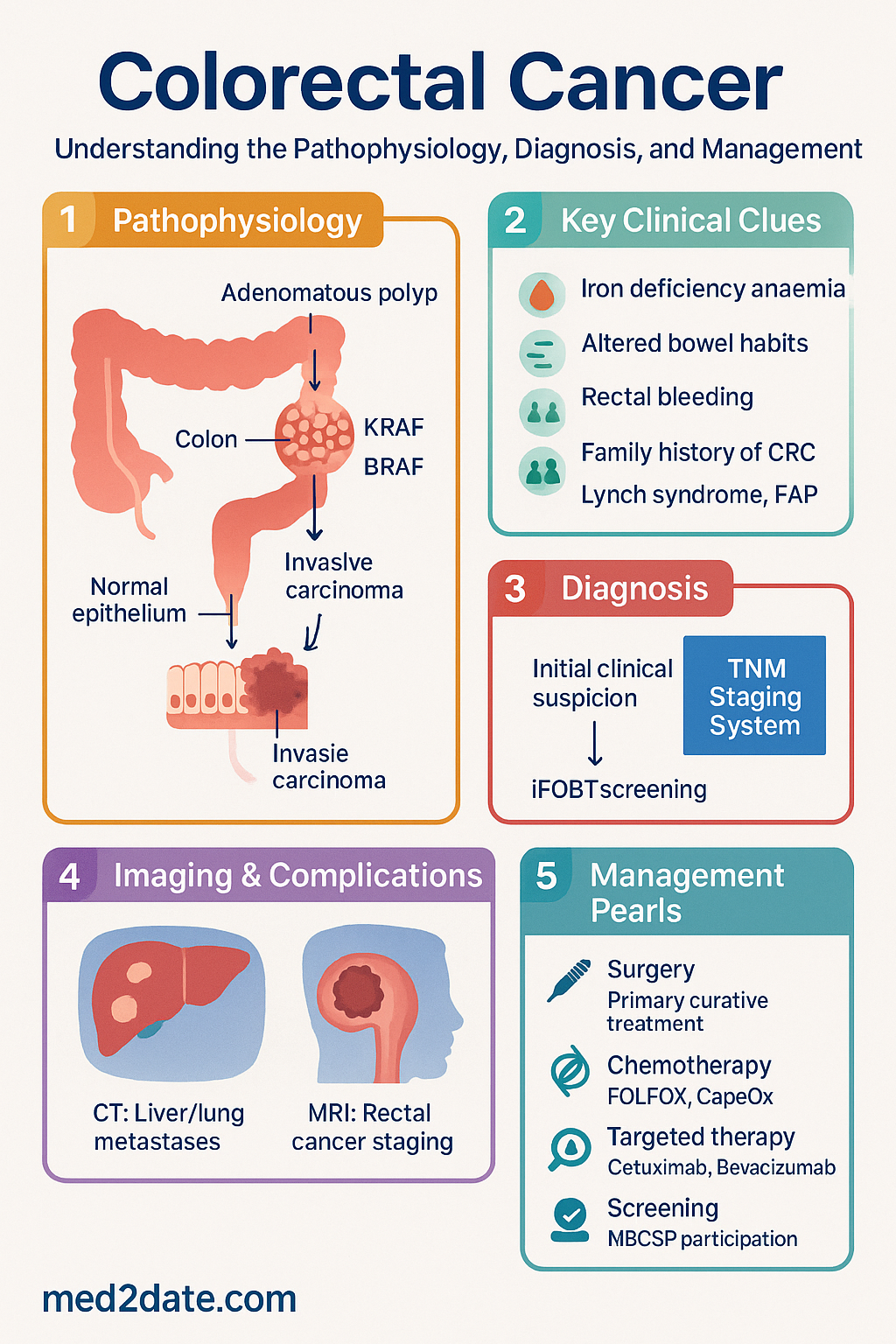
Colorectal Cancer clinical infographic — pathophysiology, clinical clues, diagnosis, imaging, and management
Tap or click image to enlarge — Colorectal Cancer: pathophysiology, clinical clues, diagnosis, imaging, and management.
Colorectal Cancer infographic, full size

Epidemiology & Risk Factors

Incidence and Trends

Age-standardised incidence rates are around 58 per 100,000 population. Incidence is slightly higher in males. While overall rates are stable or declining in those over 50, possibly due to screening, there is a concerning rise in early-onset CRC (diagnosed under 50) for reasons not yet fully understood.

Risk Factors

  • Non-modifiable: Age >50 years (strongest risk factor), male sex, personal history of CRC or adenomas, inflammatory bowel disease (ulcerative colitis, Crohn's colitis), family history of CRC in first-degree relatives, and hereditary syndromes (Lynch syndrome, FAP, MUTYH-associated polyposis).
  • Modifiable: Diet high in red and processed meats, low fibre intake, obesity (particularly central adiposity), physical inactivity, smoking, and heavy alcohol consumption.
  • Protective Factors: Regular physical activity, aspirin/NSAID use (in specific high-risk contexts after medical consultation), and a diet rich in fruits, vegetables, and whole grains.

Australian Screening

The Australian National Bowel Cancer Screening Program (NBCSP) mails iFOBT kits to all eligible Australians aged 50–74 every two years. A positive iFOBT mandates follow-up colonoscopy. Participation rates remain suboptimal (~40%), particularly in lower socioeconomic and regional/remote populations.

Pathology & TNM Staging

Histopathology

The vast majority (>95%) of colorectal cancers are adenocarcinomas. Key pathological features reported include: histological subtype (e.g., mucinous, signet ring cell), grade of differentiation, depth of invasion (pT stage), lymphovascular invasion, perineural invasion, and the number of lymph nodes examined (ideally ≥12).

Molecular Pathology

Essential molecular testing for all metastatic CRC includes:

  • RAS (KRAS/NRAS) mutation status: Predicts resistance to anti-EGFR therapies (cetuximab, panitumumab). Approximately 45% of CRCs harbour a KRAS mutation.
  • BRAF V600E mutation status: Indicates a very poor prognosis. Present in ~8-10% of cases. It is also a hallmark of sporadic microsatellite instability-high (MSI-H) tumours.
  • Microsatellite Instability (MSI) / Mismatch Repair (MMR) deficiency: Tested by immunohistochemistry (IHC) for MMR proteins (MLH1, MSH2, MSH6, PMS2) or PCR. MSI-H/dMMR tumours (15% of stage II/III) have a better prognosis in early-stage disease and predict benefit from immune checkpoint inhibitors (e.g., pembrolizumab) in the metastatic setting.

TNM Staging (AJCC/UICC 8th Edition)

Stage T (Tumour) N (Nodes) M (Metastasis) Description
0 Tis N0 M0 Carcinoma in situ (high-grade dysplasia)
I T1-T2 N0 M0 Tumour invades submucosa (T1) or muscularis propria (T2)
IIA/B/C T3/T4a/T4b N0 M0 Tumour invades through muscularis propria into pericolorectal tissues/serosa (T3) or perforates/invades adjacent structures (T4)
IIIA/B/C Any T N1/N2 M0 Metastasis to 1-3 (N1) or ≥4 (N2) regional lymph nodes
IVA/B/C Any T Any N M1a/b/c Distant metastasis: single organ (M1a), multiple organs (M1b), peritoneal metastasis +/- other sites (M1c)

Clinical Features & Investigations

Clinical Presentation

Symptoms depend on tumour location and stage. Right-sided (ascending) colon cancers often present insidiously with iron deficiency anaemia, fatigue, and occult blood loss. Left-sided (descending/sigmoid) and rectal cancers typically present with altered bowel habit, rectal bleeding, tenesmus, or symptoms of obstruction. Acute presentations include bowel obstruction or, rarely, perforation. Constitutional symptoms (weight loss, anorexia) often indicate advanced disease.

Investigations

Essential
Colonoscopy & Biopsy
The gold standard for diagnosis. Allows visualisation, biopsy, and polypectomy. Complete colonoscopy is required to exclude synchronous lesions.
Widely Available
CT Chest, Abdomen, Pelvis
Primary staging investigation to assess for distant metastases (liver, lung) and local extent. MBS item 56809.
Essential for Rectal Cancer
MRI Pelvis
Critical for locoregional staging of rectal cancer. Defines relationship to mesorectal fascia (circumferential resection margin), depth of invasion, and nodal status. MBS item 63501.
Widely Available
Baseline Bloods
FBC (anaemia), LFTs (metastases), CEA (carcinoembryonic antigen - baseline for monitoring post-resection).
Specialist Referral
PET-CT
Not routine. Role in equivocal staging, suspected recurrence, or to assess resectability of oligometastatic disease.

Treatment (Surgery, Chemotherapy & Targeted Therapy)

All patients should be discussed at a specialist multidisciplinary team (MDT) meeting. Treatment is stage-dependent.

Surgery

The mainstay of curative treatment for non-metastatic disease. The goal is a complete oncological resection with clear margins (≥5 mm for colon, ≥1 mm for rectum).

  • Colon Cancer: Segmental colectomy (e.g., right hemicolectomy, sigmoid colectomy) with high ligation of the vascular pedicle and en-bloc lymphadenectomy (≥12 nodes). Laparoscopic surgery is standard where feasible.
  • Rectal Cancer: Total Mesorectal Excision (TME) is the standard. Surgery type (anterior resection with colo-anal anastomosis, or abdominoperineal excision) depends on tumour height relative to the anal sphincter. For early T1 tumours, transanal endoscopic microsurgery (TEM) may be appropriate.
  • Emergency Surgery: Required for obstruction or perforation. May involve stent placement (bridge to surgery) or a Hartmann's procedure.

Chemotherapy & Targeted Therapy

Pharmacotherapy is used in the adjuvant (post-surgery) and metastatic settings. All regimens below are intravenous unless stated. Dose adjustments are mandatory for renal/hepatic impairment, elderly, or poor performance status.

💊
5-Fluorouracil (5-FU) / Leucovorin
Adrucil® / folinic acid · Antimetabolite backbone
Typical Adjuvant Regimen (FOLFOX) 5-FU 400 mg/m² bolus + 2400 mg/m² CIVI over 46h + Leucovorin, every 14 days
PBS Status ✔ PBS General Benefit
💊
Oxaliplatin
Eloxatin® · Platinum agent
Adjuvant (FOLFOX/CapeOx) 85 mg/m² IV Day 1, every 14 days (FOLFOX) or 130 mg/m² IV Day 1, every 21 days (CapeOx)
Key Toxicity Cumulative peripheral sensory neuropathy
PBS Status ✔ PBS General Benefit
💊
Capecitabine
Xeloda® · Oral pro-drug of 5-FU
Adjuvant (CapeOx) 1000 mg/m² PO BD, Days 1-14, every 21 days
Metastatic Monotherapy 1250 mg/m² PO BD, Days 1-14, every 21 days
Renal Adjustment Required; contraindicated if CrCl <30 mL/min
PBS Status ✔ PBS General Benefit
💊
Irinotecan
Irinotecan® · Topoisomerase I inhibitor
Metastatic (FOLFIRI) 180 mg/m² IV Day 1, every 14 days (with 5-FU/LV)
PBS Status ✔ PBS General Benefit
🎯
Cetuximab
Erbitux® · Anti-EGFR monoclonal antibody
Indication Metastatic CRC, RAS wild-type only, left-sided primary preferred
Dose 400 mg/m² loading, then 250 mg/m² weekly IV, or 500 mg/m² every 14 days
PBS Status ⚠️ PBS Authority Required
🎯
Bevacizumab
Avastin® · Anti-VEGF monoclonal antibody
Indication Metastatic CRC, regardless of RAS status, with chemotherapy backbone
Dose 5 mg/kg or 7.5 mg/kg IV every 14-21 days
PBS Status ⚠️ PBS Authority Required
⚠️
Neoadjuvant Therapy for Rectal Cancer: Standard of care for locally advanced (cT3-4 or N+) rectal cancer is long-course chemoradiotherapy (50.4 Gy in 28 fractions with concurrent 5-FU or capecitabine) followed by surgery after 6-8 weeks. Short-course radiotherapy (5x5 Gy) is an alternative. Total neoadjuvant therapy (TNT) consolidating all chemo/radiation before surgery is now a common approach.

Aboriginal and Torres Strait Islander Health Considerations

Aboriginal and Torres Strait Islander Health

Aboriginal and Torres Strait Islander peoples experience a greater burden from colorectal cancer, characterised by higher incidence in some age groups, significantly higher mortality rates (approx. 1.5x), and later stage at diagnosis. This inequity is driven by systemic and socio-economic barriers.

Screening & Early Detection
Lower participation in the NBCSP. Strategies include community-controlled health service engagement, culturally safe education, and providing iFOBT support.
Access to Care
Geographical isolation from tertiary surgical and oncology centres. Telehealth for MDT discussions and some specialist consultations is vital. Patient-assisted travel schemes (PATS) require streamlined navigation.
Cultural Safety
Health literacy, fear, and past experiences of racism in healthcare systems. Care must be delivered by culturally competent teams, with support from Indigenous Hospital Liaison Officers and integration with Aboriginal Community Controlled Health Organisations (ACCHOs).
Comorbidity Management
Higher prevalence of comorbidities (diabetes, CVD, renal disease) at diagnosis impacts treatment tolerance and outcomes. Requires integrated, holistic care models.

📚 References

  1. 1. Cancer Council Australia. Clinical practice guidelines for the prevention, early detection and management of colorectal cancer. Sydney: Cancer Council Australia; 2017. Available from: https://wiki.cancer.org.au/australia/Clinical_guidelines
  2. 2. Australian Institute of Health and Welfare (AIHW). Cancer data in Australia. Cat. no. CAN 122. Canberra: AIHW; 2023.
  3. 3. Department of Health. National Bowel Cancer Screening Program. Australian Government. Accessed 2024.
  4. 4. Amin MB, Edge SB, Greene FL, et al., editors. AJCC Cancer Staging Manual. 8th ed. New York: Springer; 2017.
  5. 5. National Health and Medical Research Council (NHMRC). Australian guidelines for the prevention and management of pressure injuries. Canberra: NHMRC; 2024. [Relevance: Surgical care standards]
  6. 6. Cancer Council Australia Colorectal Cancer Guidelines Working Party. Investigation and surgical management of colorectal cancer. In: Cancer Council Australia Clinical Guidelines Network. [Updated 2023].
  7. 7. Pharmac Benefits Scheme (PBS). Schedule of Pharmaceutical Benefits. Australian Government Department of Health. Accessed 2024.
  8. 8. National Comprehensive Cancer Network (NCCN). NCCN Clinical Practice Guidelines in Oncology: Colon Cancer. Version 2.2024.
  9. 9. Conroy T, Bosset JF, Etienne PL, et al. Neoadjuvant chemotherapy with FOLFIRINOX and preoperative chemoradiotherapy for patients with locally advanced rectal cancer (UNICANCER-PRODIGE 23): a multicentre, randomised, open-label, phase 3 trial. Lancet Oncol. 2021;22(5):702-715.
  10. 10. Australian Institute of Health and Welfare (AIHW). Aboriginal and Torres Strait Islander health performance framework 2023 summary report. Canberra: AIHW; 2023.
  11. 11. Royal Australasian College of Surgeons (RACS). Standards for the management of colorectal cancer. Melbourne: RACS; 2020.
  12. 12. André T, Shiu KK, Kim TW, et al. Pembrolizumab in Microsatellite-Instability–High Advanced Colorectal Cancer. N Engl J Med. 2020;383(23):2207-2218.
for PBS-listed medicines at participating pharmacies.
Cultural safety
Engagement with Aboriginal Community Controlled Health Organisations (ACCHOs) is essential. Cultural safety training for non-Indigenous clinicians, use of Aboriginal Health Workers and Liaison Officers, and incorporation of traditional healing practices alongside Western medicine improve treatment adherence and outcomes. Avoidance of eye contact, respect for gender-sensitive examination practices, and understanding of sorry business protocols are critical elements of culturally safe care.
Medication adherence
Complex DMARD regimens with frequent monitoring requirements present adherence challenges. Long-acting depot injections (e.g., methotrexate SC) may improve adherence compared to oral regimens. Community pharmacy partnerships through the Indigenous Pharmacy Programmes improve medication management.
Specific conditions
Rheumatic heart disease (RHD) requires secondary prophylaxis with benzathine penicillin G (BPG) 1.2 MU IM every 3–4 weeks for a minimum of 10 years or until age 21 (whichever is longer). RHD registers (e.g., NT RHD Register) facilitate recall and follow-up. The Australian RHD Endgame Strategy targets elimination by 2031.
Referral pathways
Referral through ACCHOs and Aboriginal Hospital Liaison Officers (AHLOs) improves engagement. The Specialist Outreach Assistance Programme provides funded specialist visits to remote communities. NT, WA, and QLD have specific rheumatology outreach programmes targeting Indigenous communities.

📚 References

  1. 1. Australian Institute of Health and Welfare (AIHW). Autoimmune disease in Australia. Cat. no. PHE 312. Canberra: AIHW; 2023.
  2. 2. Fraenkel L, Bathon JM, England BR, et al. 2021 American College of Rheumatology guideline for the treatment of rheumatoid arthritis. Arthritis Care Res. 2021;73(7):924–939.
  3. 3. Fanouriakis A, Kostopoulou M, Alber K, et al. 2019 update of the EULAR recommendations for the management of systemic lupus erythematosus. Ann Rheum Dis. 2019;78(6):736–745.
  4. 4. Chung SA, Langford CA, Maz M, et al. 2021 American College of Rheumatology/Vasculitis Foundation guideline for the management of antineutrophil cytoplasmic antibody-associated vasculitis. Arthritis Care Res. 2021;73(11):1583–1599.
  5. 5. Smolen JS, Landewé RBM, Bijlsma JWJ, et al. EULAR recommendations for the management of rheumatoid arthritis with synthetic and biological disease-modifying antirheumatic drugs: 2022 update. Ann Rheum Dis. 2023;82(1):3–18.
  6. 6. Australian Technical Advisory Group on Immunisation (ATAGI). Australian Immunisation Handbook. Australian Government Department of Health; 2024. Available from: immunisationhandbook.health.gov.au.
  7. 7. Rheumatic Heart Disease Australia (RHDAustralia). The 2020 Australian guideline for prevention, diagnosis, and management of acute rheumatic fever and rheumatic heart disease. 3rd ed. Darwin: Menzies School of Health Research; 2020.
  8. 8. Pharmaceutical Benefits Scheme (PBS). PBS Schedule. Australian Government Department of Health. Available from: pbs.gov.au. Accessed 2024.
  9. 9. Agarwal S, Cunnington J, Nossent J. Autoimmune disease in Indigenous Australians: a systematic review. Int J Rheum Dis. 2021;24(12):1487–1498.
  10. 10. Pisetsky DS. Antinuclear antibody testing — misunderstood or misused? Clin Immunol. 2023;255:109717.
  11. 11. Bertsias GK, Tektonidou M, Amoura Z, et al. Joint European League Against Rheumatism and European Renal Association–European Dialysis and Transplant Association (EULAR/ERA-EDTA) recommendations for the management of adult and paediatric lupus nephritis. Ann Rheum Dis. 2012;71(11):1771–1782.
  12. 12. Ledingham J, Deighton C; British Society for Rheumatology Standards, Audit and Guidelines Working Group. Update on the British Society for Rheumatology guidelines for prescribing TNFα blockers in adults with rheumatoid arthritis. Rheumatology. 2005;44(2):155–158.
  13. 13. National Health and Medical Research Council (NHMRC). National statement on ethical conduct in human research. Canberra: NHMRC; 2023 (updated).
for PBS-listed medicines at participating pharmacies.
Cultural safety
Engagement with Aboriginal Community Controlled Health Organisations (ACCHOs) is essential. Cultural safety training for non-Indigenous clinicians, use of Aboriginal Health Workers and Liaison Officers, and incorporation of traditional healing practices alongside Western medicine improve treatment adherence and outcomes. Avoidance of eye contact, respect for gender-sensitive examination practices, and understanding of sorry business protocols are critical elements of culturally safe care.
Medication adherence
Complex DMARD regimens with frequent monitoring requirements present adherence challenges. Long-acting depot injections (e.g., methotrexate SC) may improve adherence compared to oral regimens. Community pharmacy partnerships through the Indigenous Pharmacy Programmes improve medication management.
Specific conditions
Rheumatic heart disease (RHD) requires secondary prophylaxis with benzathine penicillin G (BPG) 1.2 MU IM every 3–4 weeks for a minimum of 10 years or until age 21 (whichever is longer). RHD registers (e.g., NT RHD Register) facilitate recall and follow-up. The Australian RHD Endgame Strategy targets elimination by 2031.
Referral pathways
Referral through ACCHOs and Aboriginal Hospital Liaison Officers (AHLOs) improves engagement. The Specialist Outreach Assistance Programme provides funded specialist visits to remote communities. NT, WA, and QLD have specific rheumatology outreach programmes targeting Indigenous communities.

📚 References

  1. 1. Australian Institute of Health and Welfare (AIHW). Autoimmune disease in Australia. Cat. no. PHE 312. Canberra: AIHW; 2023.
  2. 2. Fraenkel L, Bathon JM, England BR, et al. 2021 American College of Rheumatology guideline for the treatment of rheumatoid arthritis. Arthritis Care Res. 2021;73(7):924–939.
  3. 3. Fanouriakis A, Kostopoulou M, Alber K, et al. 2019 update of the EULAR recommendations for the management of systemic lupus erythematosus. Ann Rheum Dis. 2019;78(6):736–745.
  4. 4. Chung SA, Langford CA, Maz M, et al. 2021 American College of Rheumatology/Vasculitis Foundation guideline for the management of antineutrophil cytoplasmic antibody-associated vasculitis. Arthritis Care Res. 2021;73(11):1583–1599.
  5. 5. Smolen JS, Landewé RBM, Bijlsma JWJ, et al. EULAR recommendations for the management of rheumatoid arthritis with synthetic and biological disease-modifying antirheumatic drugs: 2022 update. Ann Rheum Dis. 2023;82(1):3–18.
  6. 6. Australian Technical Advisory Group on Immunisation (ATAGI). Australian Immunisation Handbook. Australian Government Department of Health; 2024. Available from: immunisationhandbook.health.gov.au.
  7. 7. Rheumatic Heart Disease Australia (RHDAustralia). The 2020 Australian guideline for prevention, diagnosis, and management of acute rheumatic fever and rheumatic heart disease. 3rd ed. Darwin: Menzies School of Health Research; 2020.
  8. 8. Pharmaceutical Benefits Scheme (PBS). PBS Schedule. Australian Government Department of Health. Available from: pbs.gov.au. Accessed 2024.
  9. 9. Agarwal S, Cunnington J, Nossent J. Autoimmune disease in Indigenous Australians: a systematic review. Int J Rheum Dis. 2021;24(12):1487–1498.
  10. 10. Pisetsky DS. Antinuclear antibody testing — misunderstood or misused? Clin Immunol. 2023;255:109717.
  11. 11. Bertsias GK, Tektonidou M, Amoura Z, et al. Joint European League Against Rheumatism and European Renal Association–European Dialysis and Transplant Association (EULAR/ERA-EDTA) recommendations for the management of adult and paediatric lupus nephritis. Ann Rheum Dis. 2012;71(11):1771–1782.
  12. 12. Ledingham J, Deighton C; British Society for Rheumatology Standards, Audit and Guidelines Working Group. Update on the British Society for Rheumatology guidelines for prescribing TNFα blockers in adults with rheumatoid arthritis. Rheumatology. 2005;44(2):155–158.
  13. 13. National Health and Medical Research Council (NHMRC). National statement on ethical conduct in human research. Canberra: NHMRC; 2023 (updated).