📋 Key Information Summary
- Chemotherapy drugs target rapidly dividing cells through four principal mechanisms: DNA alkylation, antimetabolite activity, mitotic inhibition, and topoisomerase interference.
- Alkylating agents (e.g., cyclophosphamide, ifosfamide, temozolomide) form covalent bonds with DNA bases, causing cross-links and strand breaks that prevent replication.
- Platinum compounds (cisplatin, carboplatin, oxaliplatin) form intrastrand and interstrand DNA cross-links; carboplatin dosing uses the Calvert formula (Dose = Target AUC × [GFR + 25]) and requires auc-calculator.com or validated institutional tools.
- Antimetabolites (methotrexate, 5-fluorouracil, gemcitabine, capecitabine, cytarabine) mimic nucleotide precursors, disrupting DNA and RNA synthesis; leucovorin rescue is mandatory with high-dose methotrexate.
- Antitumour antibiotics (doxorubicin, epirubicin, bleomycin, mitomycin) intercalate DNA or generate free radicals; anthracycline cumulative dose limits (doxorubicin ≤450–550 mg/m²) are critical for cardiomyopathy prevention.
- All chemotherapy in Australia is Authority Required on the PBS and dispensed through hospital or S100 pharmacies (not community PBS); prescribing requires oncology subspecialist authorisation.
- CINV prophylaxis follows MASCC/ESMO guidelines: NK1-receptor antagonist + 5-HT3 antagonist + dexamethasone for high-emetogenic regimens; olanzapine as fourth agent for refractory emesis.
- Tumour lysis syndrome prophylaxis with rasburicase or allopurinol, aggressive IV hydration, and electrolyte monitoring is essential for high-burden haematological malignancies.
- Dose modifications are mandatory for renal impairment (carboplatin, methotrexate, cisplatin), hepatic impairment (anthracyclines, taxanes, vinca alkaloids), and obesity (use actual body weight per eviQ protocols).
- Extravasation management requires immediate cessation, aspiration, and institution-specific antidote protocols (dexrazoxane for anthracyclines, hyaluronidase for vinca alkaloids).
- Pharmacogenomic testing for DPYD (before fluoropyrimidines), UGT1A1 (before irinotecan), and TPMT/NUDT15 (before thiopurines) is increasingly standard in Australian oncology centres.
- Aboriginal and Torres Strait Islander patients experience higher cancer mortality and later-stage diagnoses; culturally safe care, teleoncology access, and navigator programmes are essential to reduce disparities.
Introduction & Australian Epidemiology
Chemotherapy remains a cornerstone of systemic anticancer therapy in Australia. Cytotoxic agents work by exploiting the heightened proliferative rate of malignant cells, targeting DNA integrity, nucleotide synthesis, and mitotic machinery. While targeted therapies and immunotherapy have transformed treatment paradigms for many cancers, conventional chemotherapy retains central roles in curative regimens (e.g., testicular germ cell tumours, childhood acute lymphoblastic leukaemia), adjuvant and neoadjuvant settings (breast, colorectal, and oesophagogastric cancers), and palliative care.
In 2024, an estimated 162,000 new cancer diagnoses are expected in Australia, with over 51,000 cancer-related deaths annually (Australian Institute of Health and Welfare, AIHW). Chemotherapy is administered to approximately 250,000 patients per year across public and private facilities. Australia's Pharmaceutical Benefits Scheme (PBS) and Section 100 Highly Specialised Drugs (HSD) Programme subsidise chemotherapy through hospital-based authority prescribing, ensuring broad access but requiring specialist oncologist initiation and ongoing review.
Australian chemotherapy prescribing is guided by eviQ (Cancer Institute NSW) protocols, which provide evidence-based, consensus-reviewed treatment regimens with dose calculations, cycle scheduling, and toxicity management. These protocols align with international standards from ESMO, ASCO, and NCCN but are adapted for Australian drug availability, PBS listing status, and local antimicrobial resistance patterns.
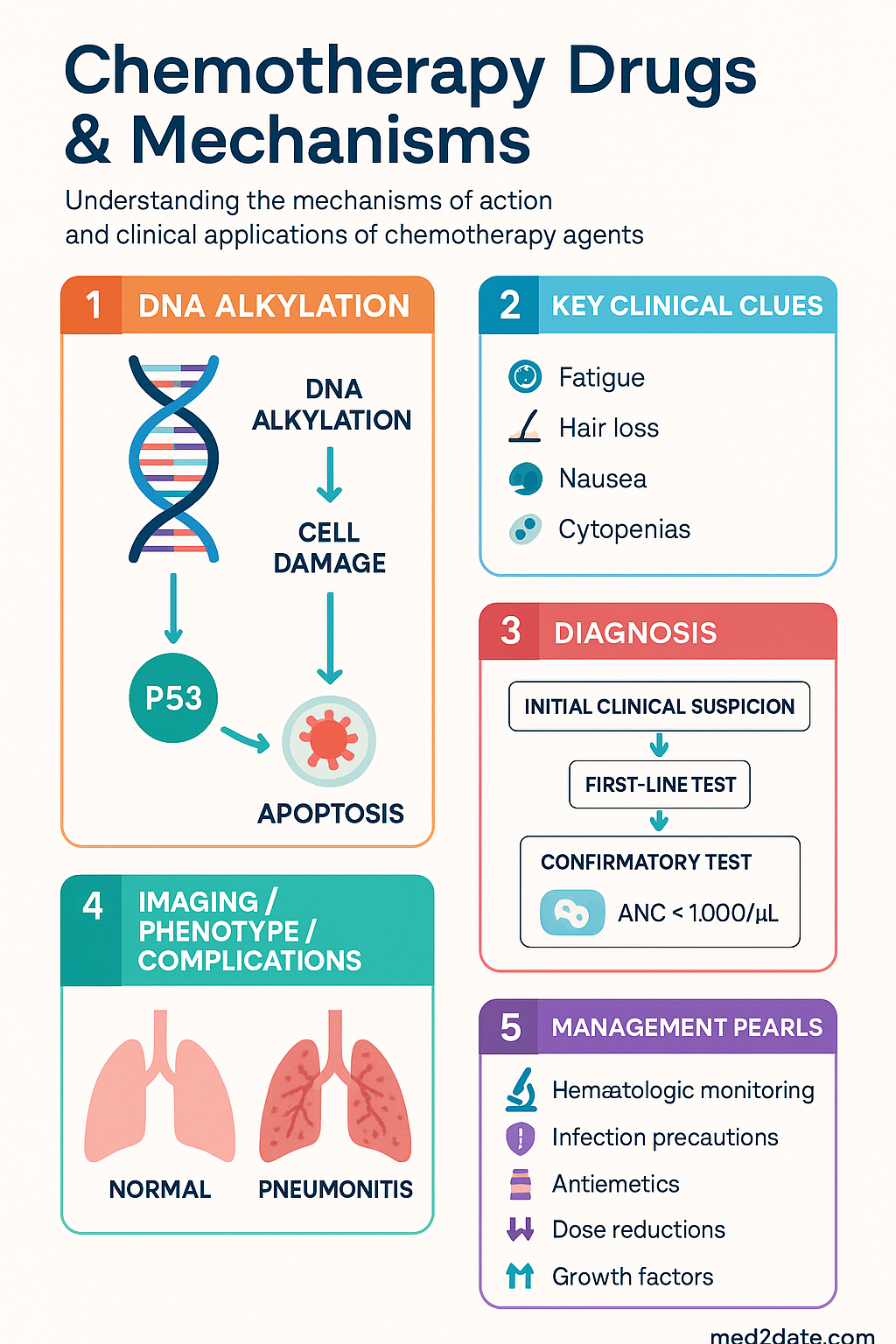
Drug Classifications & Mechanisms
Chemotherapy drugs are classified by their mechanism of action into broad pharmacological groups. Understanding these mechanisms is essential for predicting toxicities, designing combination regimens, selecting supportive care, and identifying resistance patterns.
Major Mechanism-Based Classifications
| Class | Primary Mechanism | Cell-Cycle Specificity | Key Australian Examples |
|---|---|---|---|
| Alkylating agents | DNA cross-linking and strand breaks via covalent alkylation of guanine N7 position | Cell-cycle non-specific (CCNS) | Cyclophosphamide, ifosfamide, temozolomide, bendamustine, chlorambucil |
| Platinum compounds | Intrastrand and interstrand DNA cross-links; adduct formation inhibits transcription and replication | CCNS | Cisplatin, carboplatin, oxaliplatin |
| Antimetabolites | Competitive inhibition of nucleotide synthesis enzymes or incorporation into DNA/RNA as fraudulent nucleotides | Cell-cycle specific (S-phase) | Methotrexate, 5-fluorouracil (5-FU), capecitabine, gemcitabine, cytarabine, pemetrexed, clofarabine |
| Antitumour antibiotics | DNA intercalation (anthracyclines), free radical generation, topoisomerase II inhibition | CCNS (anthracyclines); varies by agent | Doxorubicin, epirubicin, daunorubicin, bleomycin, mitomycin C, actinomycin D |
| Topoisomerase inhibitors | Stabilisation of topoisomerase–DNA cleavage complexes, preventing religation of DNA strands | S-phase / G2-phase | Irinotecan (topo I), topotecan (topo I), etoposide (topo II) |
| Mitotic inhibitors | Tubulin binding: stabilise (taxanes) or destabilise (vinca alkaloids) microtubules, blocking mitotic spindle formation | M-phase | Paclitaxel, docetaxel, nab-paclitaxel, vincristine, vinblastine, vinorelbine |
| Corticosteroids | Lymphocyte apoptosis, anti-inflammatory, tumour lysis in lymphoid malignancies | Variable | Dexamethasone, prednisolone, methylprednisolone |
| Enzymes | Depletion of essential amino acids for tumour cell metabolism | CCNS | Asparaginase (E. coli-derived, pegylated — calaspargase pegol) |
Cell-Cycle Specificity & Clinical Implications
Cell-cycle non-specific (CCNS) agents such as alkylating drugs and anthracyclines kill cells regardless of proliferative state, making them effective against slow-growing tumours. Cell-cycle specific (CCS) agents like antimetabolites and vinca alkaloids require cells to be actively cycling; prolonged exposure (e.g., continuous 5-FU infusion) may be more effective than bolus dosing. This distinction informs schedule design and explains why tumours with low growth fractions (e.g., some adenocarcinomas) may respond poorly to CCS agents alone.
Combination Chemotherapy Rationale
Most Australian regimens combine agents with non-overlapping mechanisms and toxicities to maximise tumour kill (Goldie–Coldman hypothesis) and minimise resistance emergence. Standard examples include CHOP (cyclophosphamide, doxorubicin, vincristine, prednisolone) for aggressive lymphomas and FOLFOX (5-FU, leucovorin, oxaliplatin) for colorectal cancer.
Alkylating Agents & Platinum Drugs
Alkylating agents and platinum compounds share the ability to form covalent adducts with DNA, blocking replication and transcription. They are cell-cycle non-specific, providing activity against both rapidly dividing and quiescent tumour cells.
Alkylating Agents
These drugs transfer alkyl groups to DNA bases (primarily guanine at the O6 and N7 positions), leading to mono-adducts, intrastrand cross-links, and interstrand cross-links. Resistance develops through increased DNA repair (e.g., MGMT overexpression for temozolomide), glutathione conjugation, and drug efflux pumps.
Platinum Compounds
Platinum drugs form aquated metabolites that create 1,2-intrastrand d(GpG) and d(ApG) cross-links, distorting the DNA double helix and triggering apoptotic signalling through p53-dependent and -independent pathways. Resistance mechanisms include enhanced nucleotide excision repair (NER), decreased drug uptake (CTR1), increased glutathione/metallothionein conjugation, and tolerance of DNA damage.
Antimetabolites & Antitumour Antibiotics
Antimetabolites
Antimetabolites are structural analogues of physiological nucleotides or cofactors. They are predominantly S-phase active and exert cytotoxicity by inhibiting nucleotide biosynthesis enzymes or by being incorporated into DNA/RNA, causing chain termination and strand breaks. Schedule design (continuous infusion vs bolus) profoundly affects efficacy and toxicity profiles.
Antitumour Antibiotics
This class encompasses anthracyclines (intercalating DNA topoisomerase II poisons) and non-anthracycline agents (bleomycin, mitomycin). They are potent cytotoxins with distinctive organ-specific toxicities that mandate careful cumulative dose tracking and organ function monitoring.
Toxicity Profiles & Management
Effective chemotherapy delivery requires proactive toxicity prevention, early recognition, and evidence-based management. Australian practice follows eviQ supportive care guidelines, ASCO/MASCC recommendations, and the Australian Commission on Safety and Quality in Health Care (ACSQHC) Standards for medication safety.
Chemotherapy-Induced Nausea and Vomiting (CINV)
CINV remains one of the most distressing chemotherapy side-effects. Emetogenic risk classification drives prophylaxis intensity:
Myelosuppression & Febrile Neutropenia
Myelosuppression is the most common dose-limiting toxicity of conventional chemotherapy. Australian management follows eviQ and ASCO/ESMO guidelines:
G-CSF (filgrastim, pegfilgrastim) prophylaxis: Indicated when febrile neutropenia risk is ≥20% per regimen, or ≥10% with additional risk factors (age >65, poor performance status, prior FN, extensive prior therapy, hepatic/renal impairment, open wounds, active infection). Pegfilgrastim (Neulasta®) 6 mg SC on day 2 of each cycle (not day 1 — risk of neutrophil-trapping in bone marrow). Australian PBS: Authority Required for pegfilgrastim.
Organ-Specific Toxicity Monitoring
| Organ System | Causative Agents | Monitoring | Management |
|---|---|---|---|
| Cardiac | Anthracyclines, trastuzumab, 5-FU (coronary spasm), cyclophosphamide (high-dose) | Echo/MUGA at baseline, at 200–300 mg/m² cumulative, and every 2–4 cycles thereafter; troponin if symptomatic | Dexrazoxane (cardioprotectant) above 300 mg/m² doxorubicin; switch to liposomal doxorubicin; cardiology referral for LVEF <50% or symptomatic HF; ACEi/β-blocker for cardiotoxicity |
| Renal | Cisplatin, methotrexate (crystal nephropathy), ifosfamide | Serum Cr, eGFR, electrolytes (Mg²⁺, K⁺, PO₄³⁻) before each cycle; urine output monitoring during cisplatin infusion | Aggressive IV hydration; urine alkalinisation (pH >7) for HD methotrexate; MESNA for ifosfamide; dose reduction or substitute carboplatin |
| Pulmonary | Bleomycin, gemcitabine, busulfan, methotrexate | Serial DLCO/FEV₁ for bleomycin; CT chest if new dyspnoea or dry cough; avoid FiO₂ >0.3 during GA if prior bleomycin | Stop causative agent; prednisolone 0.5–1 mg/kg/day for bleomycin pneumonitis; supportive O₂ (avoid high-flow if possible with bleomycin history) |
| Hepatic | Methotrexate (fibrosis), 6-mercaptopurine, gemcitabine (transient), busulfan | LFTs at baseline and each cycle; liver biopsy for methotrexate (cumulative dose >1.5 g if risk factors) | Dose reduction; withhold if bilirubin >3× ULN; folate supplementation with methotrexate; avoid alcohol |
| Neurological | Cisplatin, oxaliplatin, vincristine, paclitaxel, ifosfamide, high-dose cytarabine | Neurological examination each cycle; NCS for platinum neuropathy if symptomatic; oxaliplatin cumulative dose tracking | Dose reduction or stop if grade ≥2 peripheral neuropathy; duloxetine 30–60 mg/day (evidence-based for CIPN); calcium/magnesium infusion for oxaliplatin (controversial) |
Tumour Lysis Syndrome (TLS)
TLS is a metabolic emergency occurring within 6–72 hours of cytotoxic therapy initiation, most common in high-grade haematological malignancies (Burkitt lymphoma, ALL, AML with high WBC). Cairo–Bishop criteria define TLS: two or more of uric acid >8 mg/dL (0.48 mmol/L), potassium >6 mmol/L, phosphate >1.5 mmol/L, calcium <1.75 mmol/L, or Cr >1.5× ULN, within 3 days before to 7 days after therapy.
Extravasation
Chemotherapy extravasation can cause severe tissue necrosis. Immediate management includes: (1) stop infusion, (2) aspirate residual drug through the cannula if possible, (3) do NOT apply pressure, (4) mark extravasation area, (5) institute site-specific antidote protocols:
- Anthracyclines (vesicant): Dexrazoxane 1000 mg/m² IV within 6 hours (day 1), then 1000 mg/m² days 2, 3; or dimethyl sulfoxide (DMSO) 50% topical application every 8 hours × 7 days
- Vinca alkaloids (vesicant): Hyaluronidase 150 units SC × 5 injections around extravasation site; warm compresses; do NOT apply cold (worsens tissue damage)
- Non-vesicant agents (irritant): Cold compresses; elevation; standard wound care
Pharmacogenomic Considerations in Australia
Pharmacogenomic testing is increasingly integrated into Australian oncology practice to personalise chemotherapy dosing and prevent life-threatening toxicities:
| Gene | Drug | Risk | Recommendation |
|---|---|---|---|
| DPYD | 5-FU, capecitabine | Severe/fatal myelosuppression, mucositis, neurotoxicity | Test for *2A, c.2846A>T, c.1679T>G. Heterozygous: 50% dose reduction. Homozygous/compound het: contraindicated. RANZCO-endorsed. |
| UGT1A1 | Irinotecan | Severe diarrhoea and neutropenia with *28/*28 genotype | *28 homozygous: reduce starting dose by ≥30%. Consider testing if expected to receive prolonged courses. |
| TPMT / NUDT15 | 6-mercaptopurine, azathioprine | Severe myelosuppression in poor metabolisers (0.3% TPMT, higher NUDT15 in East Asian populations) | Test before first dose. TPMT/NUDT15 deficient: start at 10% of standard dose or consider alternative. TPMT heterozygous: 50–70% dose. |
| CYP2D6 | Tamoxifen (prodrug to endoxifen) | Poor metabolisers have reduced endoxifen levels and potentially reduced efficacy | Consider aromatase inhibitor (post-menopausal) or CYP2D6 testing to guide therapy choice. |
Special Populations
Aboriginal and Torres Strait Islander Health
📚 References
- 1. Cancer Institute NSW. eviQ Cancer Treatments Online. Sydney: Cancer Institute NSW; 2024. Available from: https://www.eviq.org.au
- 2. Australian Institute of Health and Welfare (AIHW). Cancer data in Australia. Cat. no. CAN 143. Canberra: AIHW; 2024.
- 3. National Health and Medical Research Council (NHMRC). Clinical practice guidelines for the management of melanoma in Australia and New Zealand. Canberra: NHMRC; 2018 (updated 2023).
- 4. Roila F, Molassiotis A, Herrstedt J, et al. 2016 MASCC and ESMO guideline update for the prevention of chemotherapy- and radiotherapy-induced nausea and vomiting and of nausea and vomiting in advanced cancer patients. Ann Oncol. 2016;27(suppl 5):v119–v133.
- 5. National Comprehensive Cancer Network (NCCN). NCCN Clinical Practice Guidelines in Oncology: Prevention and Treatment of Cancer-Related Infections. Version 2.2024. Plymouth Meeting, PA: NCCN; 2024.
- 6. Pharmaceutical Benefits Scheme (PBS). Schedule of Pharmaceutical Benefits. Australian Government Department of Health and Aged Care. Canberra; 2024. Available from: https://www.pbs.gov.au
- 7. Calvert AH, Newell DR, Gumbrell LA, et al. Carboplatin dosage: prospective evaluation of a simple formula based on renal function. J Clin Oncol. 1989;7(11):1748–1756.
- 8. Australian Commission on Safety and Quality in Health Care (ACSQHC). National Safety and Quality Health Service Standards. 2nd ed. Sydney: ACSQHC; 2021.
- 9. Dean L. Fluorouracil therapy and DPYD genotype. In: Pratt VM, Scott SA, Pirmohamed M, et al., editors. Medical Genetics Summaries. Bethesda (MD): National Center for Biotechnology Information; 2012 (updated 2023).
- 10. Cancer Council Australia. Optimal care pathway for Aboriginal and Torres Strait Islander people with cancer. 2nd ed. Melbourne: Cancer Council Australia; 2022.
- 11. Lyman GH, Kuderer NM, Crawford J, et al. American Society of Clinical Oncology 2023 update of the guideline for the use of granulocyte colony-stimulating factor. J Clin Oncol. 2023;41(24):4003–4025.
- 12. Cairo MS, Bishop M. Tumour lysis syndrome: new therapeutic strategies and classification. Br J Haematol. 2004;127(1):3–11.
- 13. Hershman DL, Lacchetti C, Dworkin RH, et al. Prevention and management of chemotherapy-induced peripheral neuropathy in survivors of adult cancers: ASCO clinical practice guideline. J Clin Oncol. 2014;32(18):1941–1967.
- 14. Safe Work Australia. Guide for handling cytotoxic drugs and related waste. Canberra: Safe Work Australia; 2023.
- 15. Australian and New Zealand Children's Haematology/Oncology Group (ANZCHOG). ANZCHOG clinical trials and supportive care guidelines. Sydney: ANZCHOG; 2024.