📋 Key Information Summary
- Antigen presentation is the process by which peptide fragments are displayed on MHC molecules to activate T lymphocytes — the cornerstone of adaptive immunity.
- MHC Class I (HLA-A, -B, -C) presents endogenous peptides from intracellular proteins to CD8⁺ cytotoxic T cells; expressed on virtually all nucleated cells.
- MHC Class II (HLA-DR, -DQ, -DP) presents exogenous peptides from extracellular proteins internalised via endocytosis to CD4⁺ helper T cells; restricted to professional antigen-presenting cells.
- The proteasome degrades cytosolic proteins into peptide fragments (8–10 amino acids) that are transported into the ER by TAP for loading onto MHC Class I.
- The endolysosomal pathway degrades extracellular proteins into peptides (13–25 amino acids) for loading onto MHC Class II after CLIP removal by HLA-DM.
- Cross-presentation allows dendritic cells to load exogenous antigens onto MHC Class I, bridging innate uptake and CD8⁺ T-cell activation — critical for anti-tumour and antiviral immunity.
- Clinical deficiencies in the MHC pathway include Bare Lymphocyte Syndrome Type I (TAP deficiency) and Type II (CIITA/RFXANK defects), causing severe combined immunodeficiency.
- HLA associations link specific alleles to autoimmune disease susceptibility (e.g., HLA-B27 with ankylosing spondylitis, HLA-DR4 with rheumatoid arthritis).
- Transplant immunology depends on MHC matching — HLA-A, -B, -DR matching reduces rejection risk; mismatched donor organs require lifelong immunosuppression.
- Tumour immune evasion frequently involves down-regulation of MHC Class I expression, enabling escape from CD8⁺ T-cell surveillance — a target for checkpoint immunotherapy.
- Antiviral defence relies on MHC Class I presentation of viral peptides; viruses such as CMV and HIV encode immune-evasion proteins that interfere with TAP, tapasin, or MHC trafficking.
- Pharmacogenomic HLA testing (e.g., HLA-B*57:01 for abacavir hypersensitivity, HLA-B*58:01 for allopurinol) is standard of care in Australia and subsidised through pathology MBS items.
- Aboriginal and Torres Strait Islander populations have distinct HLA allele frequencies relevant to disease susceptibility and transplant matching programmes.
Introduction & Australian Context
Antigen presentation via major histocompatibility complex (MHC) molecules is the fundamental molecular mechanism by which immune cells display peptide fragments to T lymphocytes, enabling immune surveillance against infections, malignancy, and altered self. In humans, the MHC is encoded within the human leukocyte antigen (HLA) locus on chromosome 6p21.3 — the most polymorphic region in the human genome, with over 25,000 described alleles as of 2024.
The clinical significance of MHC-mediated antigen presentation extends across virtually every subspecialty of medicine. In Australia, HLA typing is integral to solid organ and haematopoietic stem cell transplantation, pharmacogenomic screening (abacavir, allopurinol, carbamazepine), autoimmune disease risk assessment, and emerging immunotherapeutic strategies for malignancy. Understanding the molecular pathways of antigen processing and presentation is therefore essential for clinicians managing immunodeficiency, transplant recipients, autoimmune conditions, and cancer.
This guideline provides a structured overview of the MHC Class I endogenous pathway, the MHC Class II exogenous pathway, cross-presentation mechanisms, and the clinical applications and disease associations relevant to Australian practice.
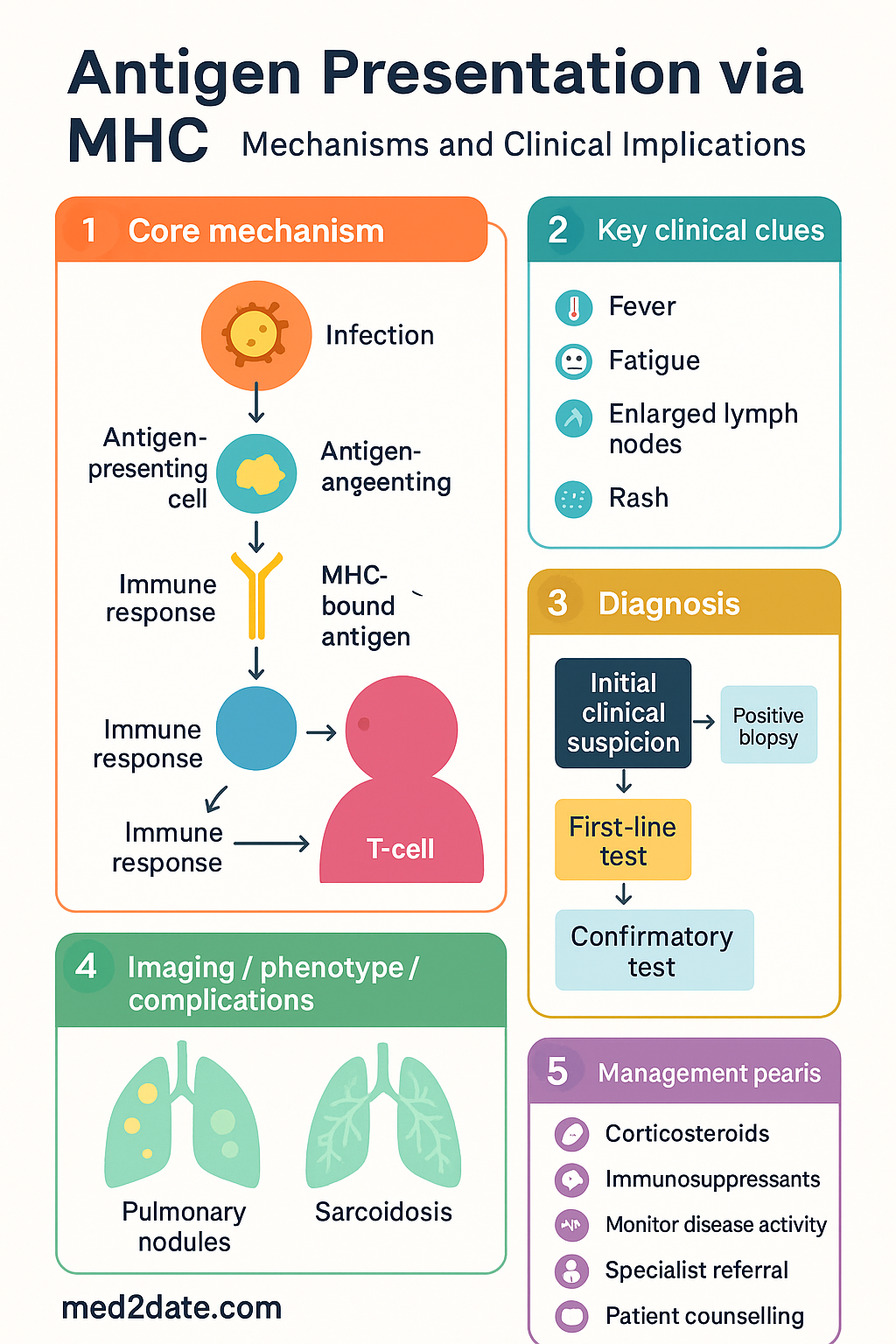
MHC Class I Pathway (Endogenous)
The MHC Class I pathway presents peptides derived from intracellular (endogenous) proteins to CD8⁺ cytotoxic T lymphocytes (CTLs). This pathway enables immune surveillance of the intracellular proteome, detecting viral infection, intracellular bacteria, and tumour-associated neo-antigens.
Molecular Steps
- Protein synthesis and proteasomal degradation: Cytosolic proteins — including viral proteins, tumour antigens, and normal self-proteins — are ubiquitinated and degraded by the constitutive 26S proteasome (or the immunoproteasome, containing LMP2, LMP7, and MECL-1 subunits induced by IFN-γ) into peptide fragments of 8–25 amino acids.
- TAP transport: Peptides are translocated from the cytosol into the endoplasmic reticulum (ER) lumen by the Transporter Associated with Antigen Processing (TAP1/TAP2 heterodimer). TAP preferentially transports peptides of 8–16 amino acids with hydrophobic or basic C-terminal residues.
- MHC Class I assembly: Newly synthesised heavy chain (α chain) associates with β₂-microglobulin in the ER. The partially folded complex is stabilised by the peptide-loading complex (PLC) comprising tapasin, ERp57, and calreticulin.
- Peptide loading: Tapasin bridges the MHC Class I molecule to TAP, facilitating peptide editing — the exchange of low-affinity peptides for high-affinity binders. Only stably loaded MHC Class I–peptide complexes are released from the PLC.
- Surface transport: Stable MHC Class I–peptide complexes traverse the Golgi apparatus and are expressed on the cell surface, where they are surveyed by CD8⁺ T cells via the αβ T-cell receptor (TCR).
Expression Pattern
MHC Class I molecules (HLA-A, HLA-B, HLA-C in humans) are expressed on virtually all nucleated cells. Red blood cells and mature trophoblast cells have minimal or absent expression. Expression is upregulated by type I and type II interferons (IFN-α/β, IFN-γ), enhancing immune surveillance during infection.
MHC Class II Pathway (Exogenous)
The MHC Class II pathway presents peptides derived from extracellular (exogenous) proteins to CD4⁺ helper T lymphocytes. This pathway is restricted to professional antigen-presenting cells (APCs) — dendritic cells, macrophages, and B lymphocytes — and is central to initiating and shaping adaptive immune responses.
Molecular Steps
- Antigen uptake: Professional APCs internalise extracellular antigens via receptor-mediated endocytosis (e.g., BCR on B cells, Fc receptors, C-type lectin receptors such as DC-SIGN and DEC-205), macropinocytosis, or phagocytosis.
- Endolysosomal processing: Internalised proteins are degraded in progressively acidified endosomal and lysosomal compartments by proteases including cathepsins (B, D, L, S) into peptide fragments of 13–25 amino acids.
- MHC Class II biosynthesis: MHC Class II α and β chains are synthesised in the ER and associate with the invariant chain (Ii; CD74). The Ii chain serves three functions: it prevents premature peptide binding, assists folding, and directs MHC Class II molecules to the endosomal compartment via its cytoplasmic targeting signals.
- CLIP removal and peptide loading: In the MHC Class II compartment (MIIC), the invariant chain is progressively degraded, leaving the CLIP (Class II-associated Invariant chain Peptide) fragment occupying the peptide-binding groove. HLA-DM catalyses the exchange of CLIP for antigenic peptides, acting as a peptide editor. HLA-DO modulates HLA-DM activity in B cells and thymic epithelium.
- Surface expression: Stable MHC Class II–peptide complexes are transported to the cell surface for presentation to CD4⁺ T cells.
Expression Pattern
Constitutive expression of MHC Class II (HLA-DR, HLA-DQ, HLA-DP) is largely restricted to professional APCs. However, expression can be induced on other cell types (epithelial cells, endothelial cells, fibroblasts) by IFN-γ via the transcription factor CIITA — a mechanism relevant to organ-specific autoimmune diseases such as thyroiditis and type 1 diabetes.
| T-Cell Subset | Key Cytokines | Function | Clinical Relevance |
|---|---|---|---|
| Th1 | IFN-γ, TNF-α, IL-2 | Macrophage activation, intracellular pathogen clearance | Granuloma formation (TB, leprosy); IFN-γ deficiency → NTM susceptibility |
| Th2 | IL-4, IL-5, IL-13 | B-cell class switching (IgE), eosinophil recruitment | Allergic disease, helminth defence; overactivation → asthma/atopy |
| Th17 | IL-17A, IL-17F, IL-22 | Neutrophil recruitment, mucosal barrier defence | Mucocutaneous candidiasis (STAT3/IL-17R defects); psoriasis, IBD |
| Tfh | IL-21, IL-4 | Germinal centre B-cell help, affinity maturation | Antibody deficiency syndromes; vaccine responses |
| Treg | IL-10, TGF-β, IL-35 | Immune suppression, tolerance maintenance | IPEX syndrome (FOXP3 mutation); transplant tolerance |
Cross-Presentation
Cross-presentation is the specialised ability of certain dendritic cell (DC) subsets to load exogenous antigens onto MHC Class I molecules, enabling CD8⁺ T-cell activation against pathogens or tumour cells that the DC itself has not directly infected. This mechanism is essential for initiating cytotoxic responses against viruses that do not infect DCs and against tumour-associated antigens.
Two Major Pathways
| Feature | Vacuolar Pathway | Cytosolic Pathway |
|---|---|---|
| Peptide generation site | Endosome/phagosome | Cytosol (proteasome) |
| Antigen escape | Not required | Endosome → cytosol (Sec61, lipid mediators) |
| TAP dependence | Independent | TAP-dependent (ER or phagosomal loading) |
| Proteasome dependence | No (cathepsins) | Yes |
| Primary DC subset | CD8α⁻ DCs (human CD1c⁺) | CD8α⁺ DCs (human CD141⁺/BDCA-3⁺) |
| Clinical significance | Viral immunity, vaccines | Anti-tumour immunity, viral defence |
Key Molecular Regulators
- NADPH oxidase (NOX2): Limits phagosomal acidification in DCs, preserving antigens for cross-presentation rather than complete lysosomal degradation.
- Rac2 and VAMP8: Regulate recruitment of early endosomal components to phagosomes, favouring cross-presentation.
- WDFY4: Recently identified as essential for cross-presentation in CD141⁺ DCs; WDFY4 deficiency impairs CD8⁺ T-cell priming.
- IRAP (insulin-regulated aminopeptidase): Trims peptides in endosomes for MHC Class I loading in the vacuolar pathway.
Clinical Relevance
Immunodeficiency — Defects in Antigen Presentation
| Disorder | Genetic Defect | Pathway Affected | Clinical Features | Management |
|---|---|---|---|---|
| Bare Lymphocyte Syndrome Type I (BLS-I) | TAP1, TAP2, or tapasin mutations | MHC Class I loading | Reduced CD8⁺ T cells; chronic necrotising granulomatous skin lesions; sinopulmonary infections | Antibiotic prophylaxis; wound care; HSCT in severe cases |
| Bare Lymphocyte Syndrome Type II (BLS-II) | CIITA, RFX5, RFXANK, RFXAP mutations | MHC Class II transcription/assembly | Absent MHC Class II expression; severe combined immunodeficiency; chronic diarrhoea, failure to thrive, opportunistic infections in infancy | HSCT (curative); IVIg, antimicrobial prophylaxis pre-transplant |
| STAT1 GOF mutations | STAT1 gain-of-function | IFN-γ signalling (MHC Class II regulation) | Chronic mucocutaneous candidiasis; vascular aneurysms; autoimmunity | JAK inhibitors (ruxolitinib); antifungal prophylaxis; HSCT for refractory disease |
HLA–Disease Associations
| HLA Allele | Associated Disease | Relative Risk (OR) | Proposed Mechanism |
|---|---|---|---|
| HLA-B27 | Ankylosing spondylitis | ~100–200 | Arthritogenic peptide presentation; misfolding → UPR/IL-23; aberrant heavy-chain homodimers |
| HLA-DRB1*04:01 | Rheumatoid arthritis | ~5–10 | Shared epitope binds citrullinated peptide; anti-CCP antibody generation |
| HLA-DQ2/DQ8 | Coeliac disease | ~7–20 | Presentation of deamidated gliadin peptides to CD4⁺ T cells; tissue transglutaminase modifies peptides |
| HLA-DRB1*15:01 | Multiple sclerosis | ~3 | Presentation of myelin-derived peptides (MBP, MOG) |
| HLA-B*57:01 | Abacavir hypersensitivity | ~900+ | Altered peptide repertoire in the HLA-B*57:01 groove triggers CD8⁺ T-cell reaction |
| HLA-B*58:01 | Allopurinol SJS/TEN | ~40–80 | Oxypurinol modifies peptide presentation; CD8⁺ T-cell-mediated cytotoxicity |
| HLA-A*31:01 | Carbamazepine hypersensitivity | ~10–25 | Drug–peptide–HLA complex alters TCR recognition |
Transplant Immunology
HLA matching is the foundation of solid organ and haematopoietic stem cell transplantation. In Australia, the national organ allocation system (managed by DonateLife and transplant organisations) uses HLA-A, -B, -DR matching as a key allocation criterion for renal transplantation. Zero-mismatch deceased donor kidneys are preferentially allocated to highly sensitised patients (cPRA >99%). For allogeneic HSCT, high-resolution HLA typing (10/10 match at HLA-A, -B, -C, -DRB1, -DQB1) is the standard, with haploidentical transplantation increasingly used when matched donors are unavailable.
Tumour Immune Evasion via MHC Down-regulation
Many tumours evade CD8⁺ T-cell surveillance by down-regulating MHC Class I expression through β₂-microglobulin mutations, epigenetic silencing of HLA genes, or TAP deficiency. This is observed in:
- Melanoma: β₂-microglobulin loss is found in ~30–40% of metastatic melanomas progressing on checkpoint inhibitors.
- Colorectal cancer: Microsatellite-unstable (MSI-H) tumours may develop β₂-microglobulin frameshift mutations.
- Lung adenocarcinoma: HLA LOH (loss of heterozygosity) correlates with immune escape and poorer response to anti-PD-1 therapy.
Strategies to overcome MHC loss include combination immunotherapy, adoptive T-cell therapy with NK cells (which detect "missing self" via killer immunoglobulin-like receptors), and oncolytic virus therapy.
Vaccine Design and Antigen Presentation
Effective vaccines must generate peptides that are efficiently presented by common MHC alleles in the target population. The global shift towards peptide-based and mRNA vaccines (e.g., COVID-19 mRNA vaccines) leverages the MHC Class I pathway for CD8⁺ T-cell priming and the Class II pathway for CD4⁺ T-helper responses and antibody generation. Adjuvants (AS01, MF59, CpG-ODN) enhance antigen presentation by activating DCs and promoting MHC upregulation and co-stimulatory molecule expression.
Special Populations
Aboriginal and Torres Strait Islander Health Considerations
📚 References
- 1. Neefjes J, Jongsma MLM, Paul P, Bakke O. Towards a systems understanding of MHC class I and MHC class II antigen presentation. Nature Reviews Immunology. 2011;11(12):823–836.
- 2. Joffre OP, Segura E, Savina A, Amigorena S. Cross-presentation by dendritic cells. Nature Reviews Immunology. 2012;12(8):557–569.
- 3. Blum JS, Wearsch PA, Cresswell P. Pathways of antigen processing. Annual Review of Immunology. 2013;31:443–473.
- 4. The MHC sequencing consortium. Complete sequence and gene map of a human major histocompatibility complex. Nature. 1999;401(6756):921–923.
- 5. Abbas AK, Lichtman AH, Pillai S. Cellular and Molecular Immunology. 10th ed. Philadelphia: Elsevier; 2022.
- 6. Robinson J, Halliwell JA, Hayhurst JH, et al. The IPD and IMGT/HLA database: allele variant databases. Nucleic Acids Research. 2015;43(Database issue):D423–D431.
- 7. Mallal S, Phillips E, Carosi G, et al. HLA-B*5701 screening for hypersensitivity to abacavir. New England Journal of Medicine. 2008;358(6):568–579.
- 8. Hung SI, Chung WH, Liou LB, et al. HLA-B*5801 allele as a genetic marker for severe cutaneous adverse reactions caused by allopurinol. Proceedings of the National Academy of Sciences. 2005;102(11):4134–4139.
- 9. Fernando MMA, Stevens CR, Walsh EC, et al. Defining the role of the MHC in autoimmunity: a review. PLoS Genetics. 2008;4(4):e1000024.
- 10. Trowsdale J, Knight JC. Major histocompatibility complex genomics and human disease. Annual Review of Genomics and Human Genetics. 2013;14:301–323.
- 11. Australian Institute of Health and Welfare (AIHW). Aboriginal and Torres Strait Islander Health Performance Framework 2023. Canberra: AIHW; 2023.
- 12. RHDAustralia (a program of Menzies School of Health Research). The 2020 Australian guideline for prevention, diagnosis and management of acute rheumatic fever and rheumatic heart disease. 3rd ed. 2020.
- 13. McLaren PJ, Carrington M. The impact of host genetic variation on HIV infection and disease outcomes. Nature Reviews Immunology. 2015;15(9):571–579.
- 14. McGranahan N, Rosenthal R, Hiley CT, et al. Allele-specific HLA loss and immune escape in lung cancer evolution. Cell. 2017;171(6):1259–1271.