📋 Key Information Summary
- Diuretics are categorised by their nephron site of action, dictating potency and electrolyte effects.
- Loop diuretics (frusemide, bumetanide) are the most potent, acting on the thick ascending limb; first-line for acute heart failure, oedema.
- Thiazide diuretics (bendroflumethiazide, HCTZ) act on the distal convoluted tubule; first-line for hypertension, also used in nephrolithiasis.
- Potassium-sparing diuretics (spironolactone, amiloride) act on the collecting duct; used for hyperaldosteronism, oedema, and as adjuncts to prevent hypokalaemia.
- Carbonic anhydrase inhibitors (acetazolamide) and osmotic diuretics (mannitol) have specialised roles (e.g., glaucoma, raised intracranial pressure).
- Monitor electrolytes (Na⁺, K⁺), renal function (eGFR, Cr), and fluid status closely, especially on initiation and dose changes.
- Combining loop and thiazide diuretics ('sequential nephron blockade') can overcome diuretic resistance but increases electrolyte disturbance risk.
- Adjust doses in renal impairment: loop diuretic dose may need increasing; thiazides become less effective at eGFR <30 mL/min.
- PBS status varies: most diuretics are General Benefit; spironolactone for heart failure is Authority Required.
- Consider Aboriginal and Torres Strait Islander patients' higher burden of heart failure and CKD, and potential barriers to monitoring.
- Avoid NSAIDs where possible, as they antagonise diuretic effect and increase renal risk.
- In pregnancy, thiazides and loop diuretics may be continued if essential; potassium-sparing diuretics are generally avoided.
Introduction & Australian Epidemiology
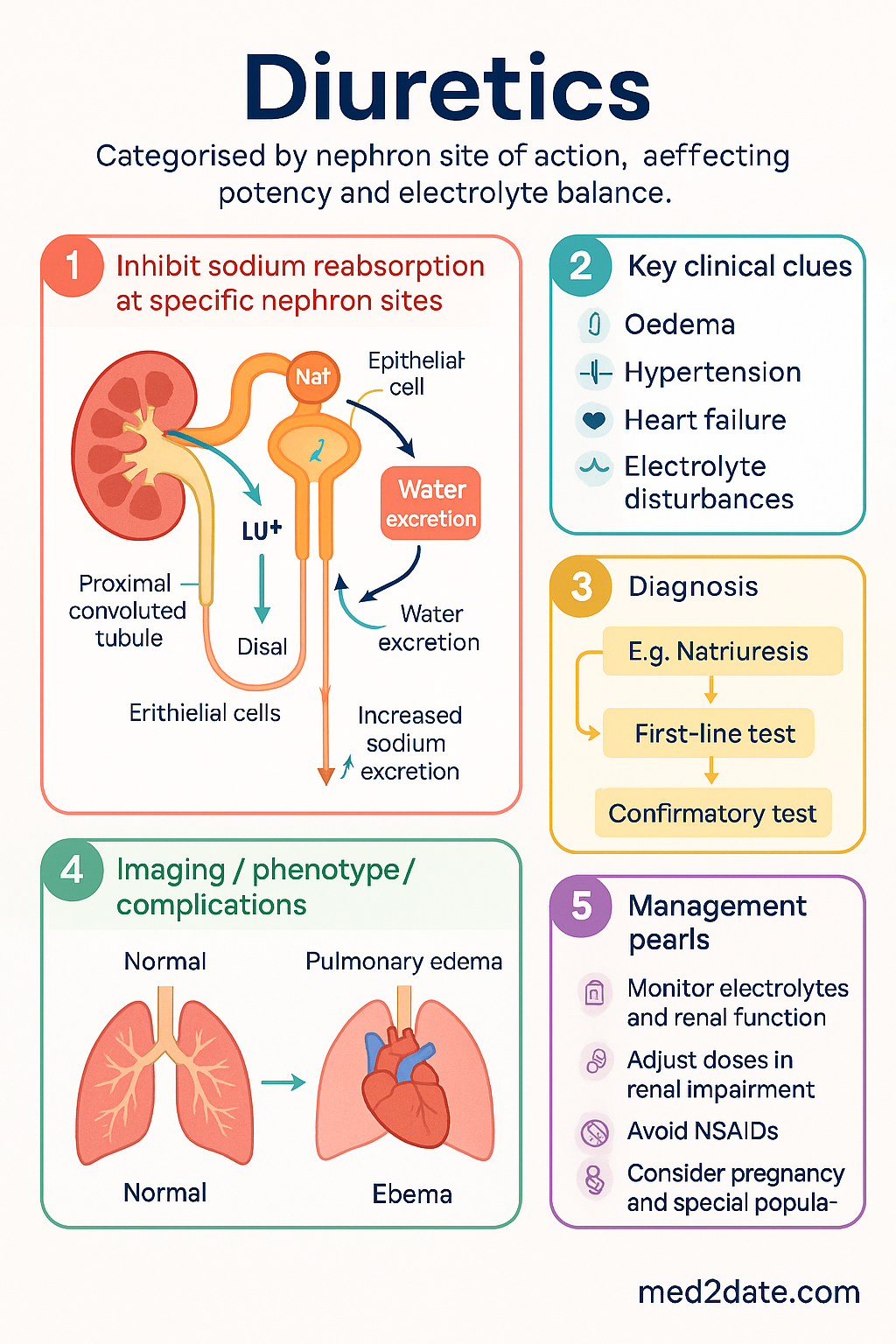
Diuretics are a cornerstone of therapy for hypertension, oedema, and heart failure. They act by inhibiting sodium reabsorption at specific sites along the nephron, leading to increased urinary sodium and water excretion. The site of action determines their potency, duration, and electrolyte side-effect profile.
In Australia, diuretics are among the most commonly prescribed cardiovascular medications. Loop diuretics are essential in managing acute decompensated heart failure, which has a prevalence of over 500,000 Australians and accounts for significant hospitalisations. Thiazide diuretics are a first-line antihypertensive, with hypertension affecting ~6 million Australian adults. The burden of chronic kidney disease (CKD) and heart failure is particularly high among Aboriginal and Torres Strait Islander peoples, making diuretic therapy and its safe monitoring critically important in these populations.
Loop Diuretics (Frusemide, Bumetanide)
Loop diuretics are high-ceiling agents that inhibit the Na⁺/K⁺/2Cl⁻ cotransporter (NKCC2) in the thick ascending limb of the loop of Henle. They are the most potent diuretics available, capable of excreting up to 25% of filtered sodium.
Pharmacology and Dosing
Indications and Clinical Use
- Acute decompensated heart failure: IV frusemide is first-line for decongestion.
- Chronic oedema: Nephrotic syndrome, cirrhosis (with spironolactone), chronic heart failure.
- Hypercalcaemia: IV frusemide after adequate saline rehydration.
- Acute pulmonary oedema: IV bolus, often combined with vasodilators.
Adverse Effects and Monitoring
- Electrolytes: Hypokalaemia, hyponatraemia, hypomagnesaemia. Monitor within 1–2 weeks of initiation/dose change.
- Ototoxicity: Rare, usually with high IV doses or rapid infusion. Use infusions ≤4 mg/min.
- Dehydration & pre-renal AKI: Monitor weight, renal function, and symptoms.
- Gout: Can precipitate acute gout by increasing urate reabsorption.
Thiazide Diuretics (Bendroflumethiazide, HCTZ)
Thiazides inhibit the Na⁺Cl⁻ cotransporter (NCC) in the distal convoluted tubule. They have a moderate diuretic effect, excreting 5–10% of filtered sodium, and are used primarily for their sustained antihypertensive action.
Pharmacology and Dosing
Indications and Clinical Use
- First-line antihypertensive: Especially for salt-sensitive hypertension and elderly patients.
- Calcium nephrolithiasis: Reduces urinary calcium excretion. Used for prevention of calcium oxalate stones.
- Nephrogenic diabetes insipidus: Paradoxically reduces urine volume by increasing proximal reabsorption.
- Oedema: Mild chronic oedema, but less potent than loop diuretics.
Adverse Effects and Monitoring
- Hypokalaemia: Common. Consider potassium supplementation or combination with K⁺-sparing agent.
- Hyponatraemia: Can be severe, especially in elderly. Monitor sodium.
- Hyperglycaemia: Can worsen glycaemic control in diabetes.
- Hyperuricaemia: Can precipitate gout.
- Photosensitivity: Advise sun protection.
Potassium-Sparing Diuretics (Spironolactone, Amiloride)
These agents act on the principal cells of the collecting duct and late distal tubule. They are weak diuretics but are valuable for their potassium-sparing and anti-aldosterone effects.
Pharmacology and Dosing
Indications and Clinical Use
- Heart failure with reduced ejection fraction (HFrEF): Spironolactone reduces mortality. PBS Authority Required.
- Primary hyperaldosteronism: Spironolactone is first-line for medical management.
- Oedema: Adjunct to loop/thiazide diuretics to prevent hypokalaemia.
- Ascites in cirrhosis: Spironolactone is the diuretic of first choice.
- Resistant hypertension: Low-dose spironolactone is effective.
Adverse Effects and Monitoring
- Gynaecomastia & menstrual irregularities: Due to anti-androgenic effects of spironolactone. Eplerenone is an alternative with less hormonal side effects.
- Gastric upset: Take with food.
Carbonic Anhydrase Inhibitors & Osmotic Diuretics
Carbonic Anhydrase Inhibitors (Acetazolamide)
Inhibit carbonic anhydrase in the proximal convoluted tubule, reducing Na⁺ and HCO₃⁻ reabsorption. Weak diuretic effect, but valuable for specific indications.
- Indications: Glaucoma, idiopathic intracranial hypertension, altitude sickness prophylaxis, metabolic alkalosis.
- Adverse effects: Paraesthesia, fatigue, metabolic acidosis, renal calculi (calcium phosphate), sulphonamide allergy cross-reactivity.
Osmotic Diuretics (Mannitol)
Freely filtered but poorly reabsorbed, creating an osmotic gradient that inhibits water reabsorption in the proximal tubule and loop of Henle.
- Indications: Reduction of raised intracranial pressure, acute glaucoma, rhabdomyolysis (to maintain urine output).
- Adverse effects: Fluid overload, hyponatraemia (then hypernatraemia), headache. Must use with caution in heart failure.
- Administration: Requires IV infusion via filter. Monitor serum osmolality (target <320 mOsm/kg).
Monitoring
Safe diuretic use requires systematic monitoring.
Special Populations
Pregnancy
Paediatrics
Elderly
Renal Impairment
Hepatic Impairment
Aboriginal and Torres Strait Islander Health Considerations
📚 References
- 1. Kidney Health Australia. Chronic Kidney Disease (CKD) Management in Primary Care. 4th ed. 2020.
- 2. National Heart Foundation of Australia & Cardiac Society of Australia and New Zealand. Guidelines for the Prevention, Detection, and Management of Heart Failure in Australia. 2018.
- 3. National Aboriginal Community Controlled Health Organisation (NACCHO). Aboriginal and Torres Strait Islander Health. Various position statements.
- 4. Australian Institute of Health and Welfare (AIHW). Heart, stroke and vascular disease—Australian facts. 2023.
- 5. The Pharmaceutical Benefits Scheme (PBS). Schedule of Pharmaceutical Benefits. Australian Government Department of Health. Accessed October 2024.
- 6. RACGP. Management of hypertension in adults in primary care. 2016.
- 7. Ellison, D.H. The Physiological Basis of Diuretic Synergism: Its Role in Treating Diuretic Resistance. Annals of Internal Medicine. 1991.
- 8. Australian Commission on Safety and Quality in Health Care (ACSQHC). Acute Kidney Injury Clinical Care Standard. 2020.
- 9. Vargo, D.L., et al. Diuretics and the Treatment of Edema. New England Journal of Medicine. 2022.
- 10. RHDAustralia (Rheumatic Heart Disease Australia). Diagnosis and Management of Acute Rheumatic Fever and Rheumatic Heart Disease. 2020.
- 11. Cardiac Society of Australia and New Zealand. Position Statement on the Use of Mineralocorticoid Receptor Antagonists in Heart Failure. 2021.