📋 Key Information Summary
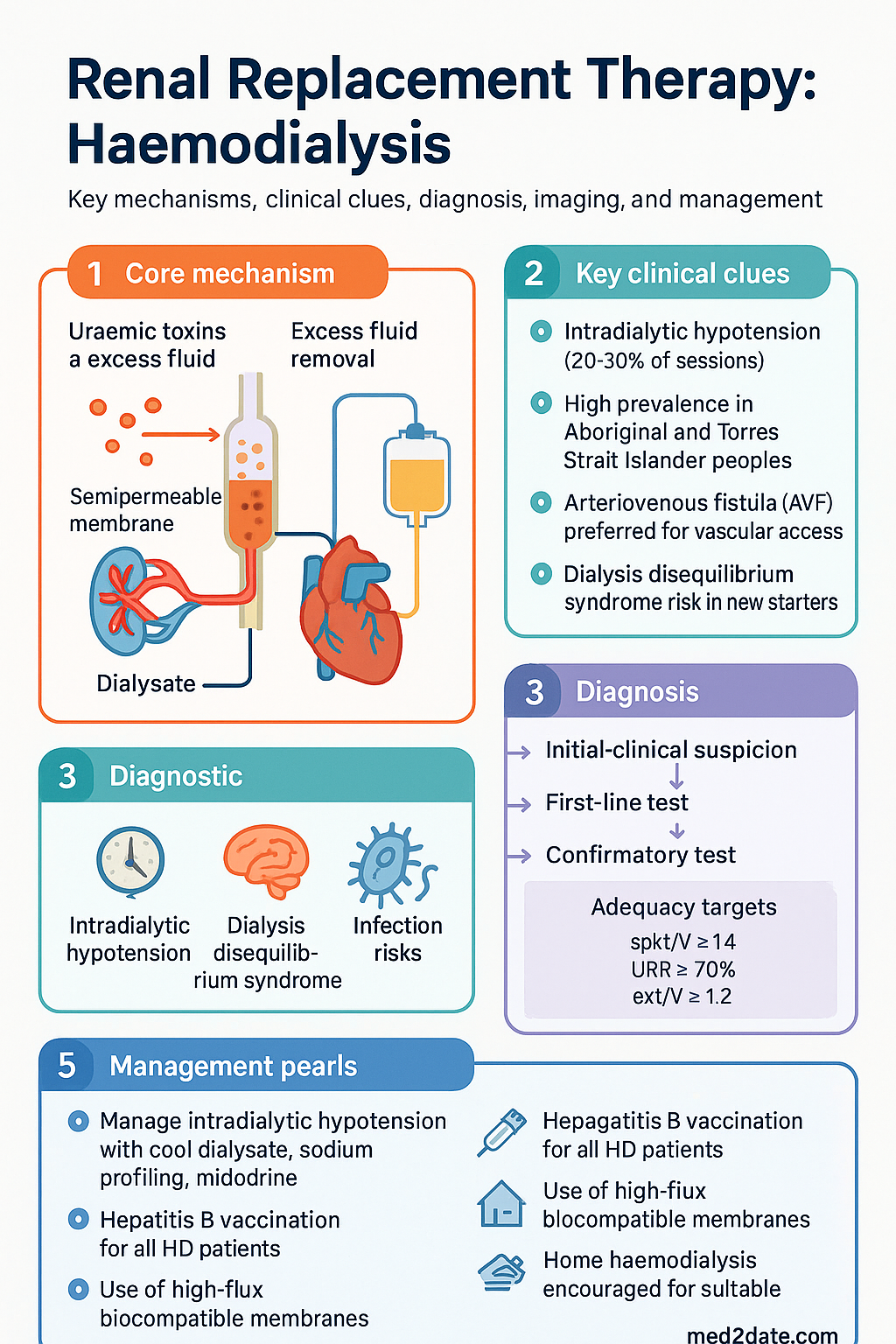
- Haemodialysis (HD) removes uraemic toxins and excess fluid via diffusion and convection across a semipermeable membrane; standard prescription is 4 hours, 3 times weekly in Australia.
- Australia has ~14,000 patients on maintenance HD (ANZDATA 2023); prevalence is highest among Aboriginal and Torres Strait Islander peoples in remote communities.
- Arteriovenous fistula (AVF) is the preferred vascular access — "fistula first" policy; target maturation time 6–12 weeks; primary patency superior to grafts and central venous catheters (CVCs).
- Tunneled CVCs carry 2–3× higher bacteraemia risk than AVFs; avoid as long-term access; right internal jugular vein is the preferred insertion site.
- Adequacy targets: single-pool Kt/V (spKt/V) ≥ 1.4 per session; URR ≥ 70%; eKt/V ≥ 1.2; re-evaluate if targets not met after optimising blood flow and session time.
- Intradialytic hypotension (IDH) is the most common acute complication (20–30% of sessions); manage with cool dialysate, sodium profiling, midodrine, and accurate dry-weight assessment.
- Dialyser re-use is NOT standard practice in Australia; single-use high-flux biocompatible membranes (polysulphone, polyethersulphone) are standard.
- Dialysis disequilibrium syndrome (DDS) risk in new starters — use reduced blood flow rate (150–200 mL/min) and shortened initial sessions; consider hypertonic saline prophylaxis.
- Hepatitis B: all HD patients must receive vaccination; seroconversion monitored; dedicated machines for HBsAg-positive patients per state guidelines.
- Anticoagulation: unfractionated heparin (UFH) is standard; citrate regional anticoagulation for patients with bleeding risk; heparin-free dialysis as alternative.
- PBS: erythropoiesis-stimulating agents (ESAs), phosphate binders, and active vitamin D analogues are Authority Required items; iron (IV ferric carboxymaltose, iron polymaltose) is PBS-listed for CKD patients.
- Home haemodialysis (HHD) is encouraged where suitable — Australian programmes report equivalent survival with improved quality of life; nocturnal HHD (6–8 hrs, 5–6 nights/week) provides superior solute clearance.
Introduction & Australian Epidemiology
Haemodialysis (HD) is the most widely used renal replacement therapy (RRT) modality worldwide. It employs diffusion and convection across a semipermeable membrane to remove uraemic toxins, correct electrolyte and acid–base disturbances, and ultrafilter excess fluid. In Australia, standard in-centre HD is typically prescribed as 4-hour sessions, 3 times per week, though home haemodialysis (HHD) and extended/nocturnal regimens are increasingly adopted.
According to the Australia and New Zealand Dialysis and Transplant Registry (ANZDATA), approximately 14,000 Australians were receiving maintenance dialysis at the end of 2022, with HD accounting for roughly 75% of all dialysis patients. The crude incidence of treated end-stage kidney disease (ESKD) is approximately 12 per million population per year in the non-Indigenous population, rising to >50 per million in Aboriginal and Torres Strait Islander communities — a disparity driven by the high prevalence of type 2 diabetes, hypertension, and delayed presentation to nephrology services.
Australia operates a mix of public hospital-based, private satellite, and home HD programmes. Medicare and the National Disability Insurance Scheme (NDIS) cover HD costs; the majority of patients receive treatment in publicly funded hospital or satellite units. Home haemodialysis is actively promoted by Kidney Health Australia and the National Aboriginal Community Controlled Health Organisation (NACCHO) as a strategy to improve patient autonomy and reduce the burden of travel, particularly for patients in regional and remote areas.
Principles of Haemodialysis
Diffusion
The primary solute removal mechanism. Uraemic toxins (urea, creatinine, potassium, phosphate) move down their concentration gradient from blood to dialysate across the semipermeable membrane. Small molecules (<500 Da) clear rapidly; middle molecules (β₂-microglobulin, 11,800 Da) require high-flux membranes and convective clearance.
Convection (Ultrafiltration)
Hydrostatic pressure drives plasma water (and solutes dissolved in it) across the membrane — "solvent drag." Essential for fluid removal and middle-molecule clearance. In haemodiafiltration (HDF), substitution fluid replacement augments convective transport; HDF is increasingly used in Australia with reported survival benefit in large European trials (ESHOL, CONTRAST).
Membrane Characteristics
| Feature | Low-Flux | High-Flux |
|---|---|---|
| Ultrafiltration coefficient (Kuf) | <10 mL/hr/mmHg | >20 mL/hr/mmHg |
| β₂-microglobulin clearance | Minimal | >20 mL/min |
| Typical material | Cellulose acetate, cuprophane | Polysulphone, polyethersulphone, AN69 |
| Biocompatibility | Lower | Higher |
| Australian standard use | Rarely used | Standard of care |
Dialysate Composition (Standard Bicarbonate Dialysate)
| Component | Concentration |
|---|---|
| Sodium | 138–140 mmol/L |
| Potassium | 2.0 mmol/L (range 1–4) |
| Calcium | 1.25–1.75 mmol/L |
| Magnesium | 0.5–0.75 mmol/L |
| Bicarbonate | 32–40 mmol/L |
| Glucose | 5.5 mmol/L (100 mg/dL) |
Water Treatment
Dialysis water must meet AS/NZS 4753 and the Australian Commission on Safety and Quality in Health Care (ACSQHC) standards. Reverse osmosis, deionisation, and ultrafiltration are used in series. Bacterial endotoxin must be <0.25 EU/mL (ultrapure) or <0.03 EU/mL (ultrapure for HDF). Water quality is monitored quarterly by pathology services or private water treatment companies accredited under NATA.
Vascular Access (AVF, AVG, CVC)
Vascular access is the lifeline for HD. The Kidney Disease Outcomes Quality Initiative (KDOQI) and the Caring for Australasians on Renal Impairment (CARI) guidelines endorse a "fistula-first" approach. AVFs have the lowest infection rates, best long-term patency, and lowest overall cost.
AVF Planning & Referral Timing
- Refer to vascular access surgeon when eGFR <20 mL/min/1.73 m² (or <15 mL/min if rapidly declining).
- Pre-operative vascular mapping by duplex ultrasound — MBS item 55221 (renal dialysis access planning ultrasound).
- Preserve non-dominant arm veins — avoid venipuncture, IV cannulae, and PICC lines in the non-dominant forearm.
- Maturation assessment at 4–6 weeks post-creation by clinical exam and ultrasound; promote maturation with squeeze-ball exercises.
AVF Complications
| Complication | Incidence | Management |
|---|---|---|
| Primary failure (non-maturation) | 20–50% | Percutaneous angioplasty (PTA); surgical revision; new access site |
| Stenosis | Common (anastomotic, cephalic arch) | Surveillance ultrasound Q3–6 months; PTA if >50% stenosis with clinical signs |
| Thrombosis | 0.5–1.0 per access-year | Surgical thrombectomy, pharmacomechanical thrombolysis; MBS item 35302 |
| Aneurysm / pseudoaneurysm | Variable | Monitor if stable; surgical repair if enlarging, painful, or skin breakdown |
| Infection (AVF) | Rare (<1%) | IV antibiotics (flucloxacillin or vancomycin if MRSA risk); surgical drainage if abscess |
| Infection (CVC) | 2.5–5.5 per 1000 catheter-days | See CVC-related bacteraemia management below |
| Steal syndrome | 1–8% | DRIL procedure (distal revascularisation-interval ligation), banding, or ligation |
CVC-Related Bloodstream Infection (CRBSI)
Empirical antibiotics: IV vancomycin 25 mg/kg (max 2 g) loading dose + IV gentamicin 2 mg/kg (dose post-HD session, adjusted for residual renal function) pending culture results. If Staphylococcus aureus bacteraemia confirmed: treat for 4–6 weeks; remove CVC if possible; obtain transoesophageal echocardiogram (TOE) to exclude endocarditis. Lock therapy (ethanol or taurolidine) may be used as adjunct but does not replace systemic antibiotics.
AVF/AVG Cannulation Technique
Buttonhole technique (same-site cannulation with blunt needles after track formation) is suitable for home HD patients — reduces pain and complication rates. Rope-ladder technique (alternating sites along the fistula) is standard in-centre. Area puncture should be avoided due to aneurysm risk. Australian nursing training programmes (e.g., Kidney Health Australia Home HD Training) include cannulation competency modules.
Adequacy (Kt/V, URR)
Dialysis adequacy measures ensure sufficient solute removal and are used to guide prescription adjustments. The two most widely used metrics in Australian units are the single-pool Kt/V (spKt/V) and the urea reduction ratio (URR).
Key Definitions
- Kt/V: K = dialyser clearance (mL/min), t = session duration (min), V = patient's urea distribution volume (mL). Represents the volume of plasma cleared of urea per session, normalised to V. spKt/V calculated by the Daugirdas second-generation equation.
- URR: (Pre-BUN − Post-BUN) / Pre-BUN × 100. Simpler to calculate but does not account for ultrafiltration volume.
- eKt/V (equilibrated): Accounts for urea rebound post-dialysis. Typically 0.2 units lower than spKt/V. Used in some Australian units for extended or nocturnal regimens.
Adequacy Targets (KDOQI / CARI / Australian Practice)
| Metric | Minimum Target | Comment |
|---|---|---|
| spKt/V (standard 4-hr session) | ≥ 1.4 per session | KDOQI minimum; Australian units target ≥1.4 |
| eKt/V (standard 4-hr session) | ≥ 1.2 per session | Accounts for rebound; more relevant for thrice-weekly |
| URR | ≥ 70% | Simple surrogate; does not capture ultrafiltration contribution |
| nPCR / nPNA | ≥ 1.0 g/kg/day | Normalised protein catabolic rate — marker of nutritional status |
Measurement Protocol
- Monthly pre- and post-dialysis blood urea nitrogen (BUN) samples — MBS item 66804 (monthly dialysis review).
- Post-dialysis BUN: draw 10–20 seconds after slowing blood pump to 50–100 mL/min (slow-flow method) to minimise access recirculation artefact.
- Quarterly: serum bicarbonate (pre-dialysis, target ≥22 mmol/L), albumin, calcium, phosphate, PTH, haemoglobin, iron studies.
- Access recirculation >15% suggests access dysfunction — investigate with duplex ultrasound.
Strategies to Improve Adequacy
Complications & Management
Acute / Intradialytic Complications
| Complication | Frequency | Key Management |
|---|---|---|
| Intradialytic hypotension (IDH) | 20–30% of sessions | Trendelenburg position; NS 100–200 mL bolus; reduce UF rate; cool dialysate (35.5°C); midodrine 2.5–10 mg PO pre-HD; re-evaluate dry weight |
| Cramps | 5–20% | NS bolus; reduce UF rate; quinine sulfate 200–300 mg PO (PBS-listed); stretching; sodium profiling |
| Nausea / vomiting | 5–15% | Ondansetron 4 mg IV/PO; assess for IDH, disequilibrium, or dialysate issues |
| Headache / disequilibrium | Common in new starters | Reduce QB for first sessions; hypertonic saline (3%) 30–50 mL bolus; mannitol 1 g/kg IV (rarely needed) |
| Fever / rigors (dialyser reaction) | Rare with biocompatible membranes | Stop dialysis; blood cultures; empiric antibiotics if sepsis suspected; consider endotoxin in water/dialysate |
| Anaphylaxis / hypersensitivity | <1% | Stop dialysis immediately; adrenaline 500 mcg IM; switch membrane type (avoid AN69 if ACE-inhibitor co-prescribed) |
| Air embolism | Rare | Clamp lines; Trendelenburg left lateral; 100% O₂; aspirate air via CVC if possible; call code blue |
| Blood leak | Rare | Machine alarms automatically; stop dialysis; do not return blood; replace dialyser |
Chronic / Long-Term Complications
| Complication | Mechanism / Notes | Management |
|---|---|---|
| Cardiovascular disease | Leading cause of death (40–50%); LVH, accelerated atherosclerosis, arrhythmias | BP target <140/90 mmHg (pre-dialysis); statins (PBS-listed atorvastatin); smoking cessation; fluid management; assess for sleep apnoea |
| CKD-MBD | Hyperphosphataemia, secondary hyperparathyroidism, adynamic bone disease | Phosphate binders (sevelamer, calcium carbonate — PBS Authority); cinacalcet (PBS Authority Required); active vitamin D (calcitriol, alfacalcidol — PBS General Benefit) |
| Anaemia | EPO deficiency, iron deficiency, inflammation | Target Hb 100–115 g/L; darbepoetin alfa (PBS Authority — Aranesp®); IV iron (ferric carboxymaltose — Ferinject® PBS; iron polymaltose — Ferrosig®) |
| Infection (non-access) | Immunodeficiency of uraemia; influenza, pneumococcal, COVID-19 risk | Annual influenza vaccine; 23vPPV then 13vPCV (National Immunisation Programme); COVID-19 boosters; HBV vaccination series |
| Amyloidosis (DRA) | β₂-microglobulin deposition after >10 years on HD | High-flux dialyser or HDF; consider transplant referral; symptomatic management (NSAIDs avoided; paracetamol, joint aspiration) |
| Depression & fatigue | Prevalence 20–30%; underdiagnosed | PHQ-9 screening annually; CBT; SSRIs (sertraline preferred — renally safe); peer support; consider exercise programme |
| Malnutrition | Protein-energy wasting; catabolic state | Dietitian review (MBS GPMP); protein intake 1.0–1.2 g/kg/day; oral nutritional supplements (PBS-eligible in some cases); pre-dialysis snacks |
Anticoagulation During Haemodialysis
Heparin-Free Dialysis Protocol
- Indicated for: active bleeding, post-operative (within 48–72 hrs), thrombocytopenia, HIT (heparin-induced thrombocytopenia).
- Flush lines with 100–200 mL NS every 15–30 minutes (saline push method).
- Consider reduced session time; increase monitoring of transmembrane pressure (TMP) for clotting.
- For HIT: switch to argatroban (off-label for HD in Australia — requires haematology consultation) or citrate regional anticoagulation.
Investigations
Routine investigations are essential for monitoring HD adequacy, detecting complications, and guiding therapy. The following schedule aligns with CARI/KDOQI guidelines and Australian laboratory practice.
Dialysis Water Quality Testing
- Bacterial culture and endotoxin assay: quarterly (monthly for HDF).
- Chemical analysis (aluminium, chloramine, fluoride): per AS/NZS 4753 — typically annually or after system changes.
- Performed by NATA-accredited laboratories; results documented in unit quality records.
Special Populations
Aboriginal and Torres Strait Islander Health Considerations
Quick Reference — HD Prescription Summary
📚 References
- 1. Australia and New Zealand Dialysis and Transplant Registry (ANZDATA). ANZDATA 45th Annual Report 2022. Adelaide: SA Health and Medical Research Institute; 2023.
- 2. Kidney Disease Outcomes Quality Initiative (KDOQI). KDOQI Clinical Practice Guideline for Hemodialysis Adequacy: 2015 Update. Am J Kidney Dis. 2015;66(5):884-930.
- 3. Caring for Australasians on Renal Impairment (CARI). CARI Guidelines: Haemodialysis Adequacy. 2012. Available at: www.cari.org.au.
- 4. Kidney Disease: Improving Global Outcomes (KDIGO) CKD-MBD Update Work Group. KDIGO 2017 Clinical Practice Guideline Update for the Diagnosis, Evaluation, Prevention, and Treatment of CKD-MBD. Kidney Int Suppl. 2017;7(1):1-59.
- 5. Maduell F, Moreso F, Pons M, et al. High-efficiency postdilution online hemodiafiltration reduces all-cause mortality in hemodialysis patients. J Am Soc Nephrol. 2013;24(3):487-497 (ESHOL trial).
- 6. Grooteman MPC, van den Dorpel MA, Bots ML, et al. Effect of online hemodiafiltration on all-cause mortality and cardiovascular outcomes. J Am Soc Nephrol. 2012;23(6):1087-1096 (CONTRAST trial).
- 7. Lok CE, Huber TS, Lee T, et al. KDOQI Clinical Practice Update on Vascular Access: 2019 Update. Am J Kidney Dis. 2020;75(4):487-510.
- 8. Mokrzycki MH, Lok CE. Traditional and non-traditional strategies to optimize catheter function: go with more flow. Kidney Int. 2010;78(12):1218-1231.
- 9. Daugirdas JT. Second generation logarithmic estimates of single-pool variable volume Kt/V: an analysis of error. J Am Soc Nephrol. 1993;4(5):1205-1213.
- 10. Australian Commission on Safety and Quality in Health Care (ACSQHC). National Safety and Quality Health Service Standards. 2nd ed. Sydney: ACSQHC; 2021.
- 11. Standards Australia. AS/NZS 4753: Water quality for haemodialysis and related applications. 2013.
- 12. Australian Institute of Health and Welfare (AIHW). Chronic kidney disease in Aboriginal and Torres Strait Islander people. Cat. no. PHE 254. Canberra: AIHW; 2023.
- 13. Hughes JT, Dembski L, Kerrigan V, et al. Gathering perspectives — Aboriginal and Torres Strait Islander perspectives on kidney care. Nephrology. 2020;25(8):623-631.
- 14. Royal Australasian College of Physicians (RACP). Adult Active Refusal of Life-Prolonging Medical Treatment — Position Statement. Sydney: RACP; 2018.
- 15. Purple House (Western Desert Nganampa Walytja Palyantjaku Tjutaku Aboriginal Corporation). Community-based dialysis and renal support services. Available at: www.purplehouse.org.au.