📋 Key Information Summary
- Kidney transplant immunosuppression follows a universal triple-drug regimen: a calcineurin inhibitor (tacrolimus), an anti-metabolite (mycophenolate), and corticosteroids (prednisolone).
- Induction therapy with basiliximab (IL-2 receptor antagonist) is standard for low–moderate immunological risk; anti-thymocyte globulin (thymoglobulin) is reserved for high-risk recipients (high PRA, re-transplant, young ATSI donors).
- Tacrolimus trough targets are 8–12 ng/mL in the first 3 months, 5–8 ng/mL from 3–12 months, and 4–6 ng/mL thereafter, adjusted for rejection history and concurrent agents.
- Mycophenolate mofetil (MMF) is dosed at 1 g BD for adults; target MPA AUC₀₋₁₂ₕ 30–60 mg·h/L where therapeutic drug monitoring is available.
- Prednisolone is tapered from 20–25 mg/day to 5 mg/day by month 3–6; steroid withdrawal is considered only in selected low-risk patients under specialist supervision.
- BK virus nephropathy (BKVN) occurs in 1–10% of recipients; screen plasma BK viral load monthly for the first 6–12 months, then quarterly for 2 years.
- CMV disease is the most common post-transplant viral infection; D+/R− mismatch carries the highest risk — valganciclovir prophylaxis for 3–6 months is mandatory.
- Post-transplant malignancy risk is 3–5× the general population; PTLD occurs in 1–3%, most commonly EBV-driven B-cell lymphoma within the first year.
- Reduce immunosuppression in a stepwise fashion for BKVN (first MMF, then tacrolimus) and for malignancy (minimise CNIs, consider mTOR inhibitor conversion).
- Aboriginal and Torres Strait Islander recipients have higher rates of CMV, BK, and late rejection; culturally safe follow-up and enhanced viral monitoring are essential.
- All transplant medications require PBS Authority approval; ensure continuity of supply through hospital outpatient pharmacy or shared-care agreements with community pharmacy.
- Lifelong nephrology follow-up with protocol biopsies at 3 and 12 months detects subclinical rejection and guides immunosuppression optimisation.
Introduction & Australian Epidemiology
Post-transplant immunosuppression is the cornerstone of graft survival following renal transplantation. The fundamental strategy involves a universal triple-drug regimen — comprising a calcineurin inhibitor (CNI), an anti-metabolite, and corticosteroids — designed to prevent T-cell–mediated acute rejection while minimising the long-term consequences of over-immunosuppression, including infection, malignancy, nephrotoxicity, and metabolic complications.
In Australia, over 1,400 kidney transplants are performed annually, with the majority from deceased donors. Five-year graft survival exceeds 90% for living-donor and 85% for deceased-donor recipients. Despite these excellent outcomes, managing the balance between rejection prevention and minimising adverse effects remains a lifelong clinical challenge. The ANZDATA Registry reports acute rejection rates of 10–15% in the first year, declining with modern induction and maintenance protocols.
Australian practice is guided by The Transplantation Society of Australia and New Zealand (TSANZ) consensus statements, the Australian Kidney Trials Network (AKTN) trial data, and adapted international guidelines from KDIGO and ERA-EDTA. This guideline provides a comprehensive framework for induction, maintenance, and complication management, with emphasis on Australian drug availability, PBS considerations, and health equity for Aboriginal and Torres Strait Islander peoples.
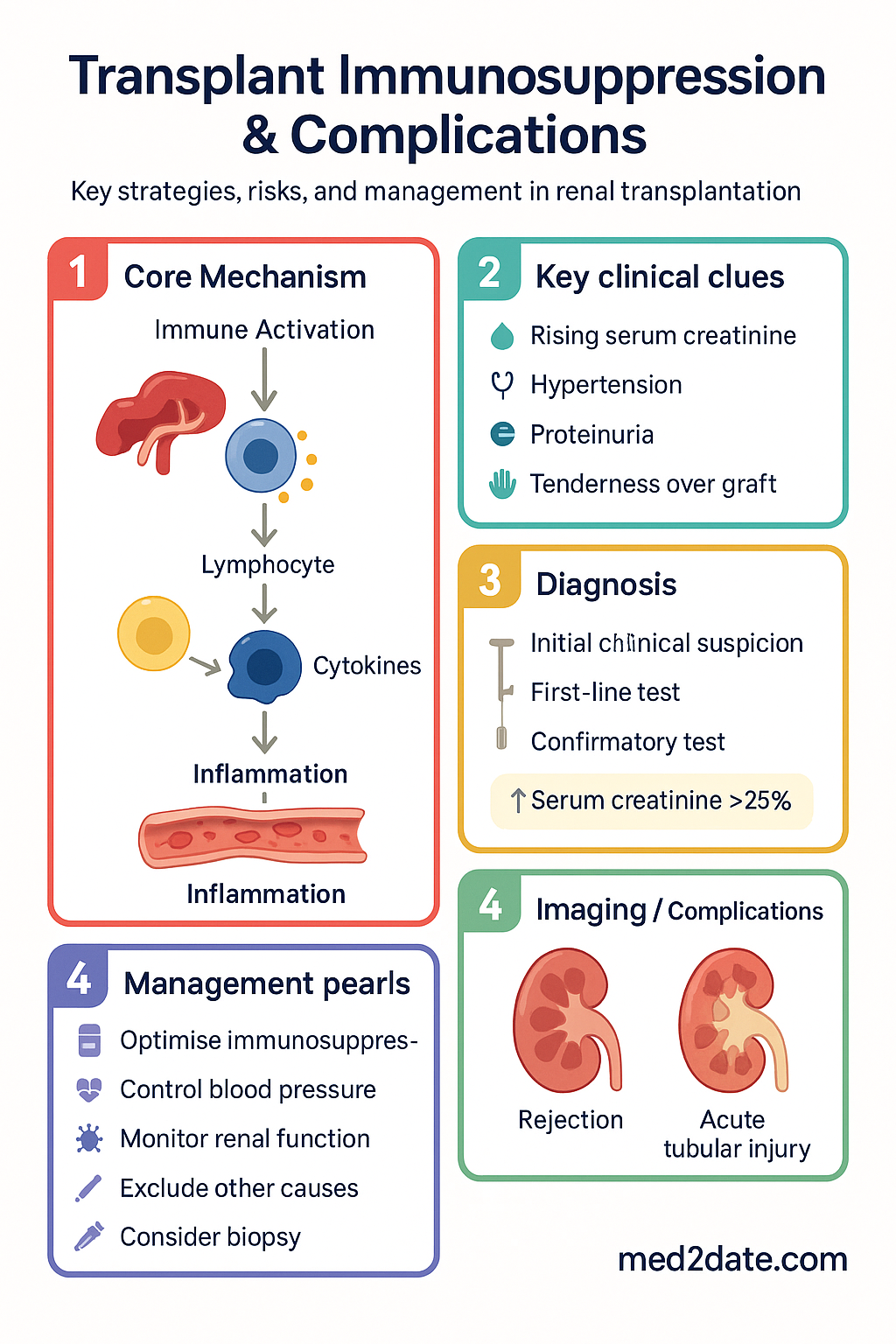
Induction Therapy — Basiliximab & Thymoglobulin
Induction therapy is administered peri-operatively to provide intense initial immunosuppression during the highest risk period for acute rejection. The choice of agent is stratified by immunological risk.
Immunological Risk Stratification
Basiliximab (Simulect®)
Basiliximab is a chimeric monoclonal antibody targeting the IL-2 receptor alpha chain (CD25) on activated T-cells. It provides selective immunosuppression without broad lymphocyte depletion.
Anti-Thymocyte Globulin — Rabbit (Thymoglobulin®)
Rabbit ATG (rATG) is a polyclonal antibody preparation that causes profound T-cell depletion through complement-dependent lysis and apoptosis. It provides powerful rejection prophylaxis but carries greater infectious and malignancy risk.
Maintenance Immunosuppression — Tacrolimus, MMF & Prednisolone
The standard Australian maintenance triple-therapy regimen consists of tacrolimus (CNI), mycophenolate mofetil (anti-metabolite), and prednisolone (corticosteroid). This combination is used in >85% of Australian kidney transplant recipients.
Tacrolimus (Prograf® / FK-506)
Mycophenolate Mofetil (CellCept® / Myfortic®)
Prednisolone
Trough Level Monitoring — Tacrolimus
| Time Period | Target Trough (ng/mL) | Monitoring Frequency | Notes |
|---|---|---|---|
| Week 1–2 | 10–15 | Daily | Initiation phase; check on Day 3 then daily until stable |
| Month 1–3 | 8–12 | Weekly → fortnightly | Highest rejection risk period |
| Month 3–12 | 5–8 | Monthly | Reduce if CMV/BK detected |
| >12 months | 4–6 | Every 2–3 months | Lower targets reduce nephrotoxicity and malignancy risk |
BK Nephropathy & CMV After Transplant
BK Virus Nephropathy (BKVN)
BK polyomavirus reactivation is a significant cause of graft dysfunction, occurring in 1–10% of renal transplant recipients. BKVN — histologically confirmed polyomavirus-associated nephropathy (PVAN) — carries a 10–50% graft loss risk if not identified early. There is no proven antiviral therapy; management centres on immunosuppression reduction.
BK Screening Protocol (Australian Standard)
BKVN Management Algorithm
Cytomegalovirus (CMV) Disease
CMV is the most clinically important viral infection post-transplant, affecting 8–32% of renal recipients. It causes direct disease (fever, pneumonitis, colitis, retinitis, hepatitis) and indirect effects (acute rejection, graft dysfunction, cardiovascular events, increased mortality).
Risk Stratification by CMV Serostatus
| Donor / Recipient | Risk Category | Prophylaxis Duration | Agent |
|---|---|---|---|
| D+ / R− | Highest | 6 months | Valganciclovir |
| D+ / R+ | High | 3–6 months | Valganciclovir |
| D− / R+ | Moderate | 3 months | Valganciclovir |
| D− / R− | Low | Consider prophylaxis if ATG induction used | Valaciclovir or valganciclovir |
CMV Treatment (Active Disease)
CMV disease requires IV ganciclovir (5 mg/kg IV BD, renal adjusted) for severe or tissue-invasive disease, followed by oral valganciclovir. Quantitative CMV PCR should be monitored weekly during treatment and fortnightly for 3 months post-clearance. Reduce immunosuppression concurrently — typically stop MMF first, then reduce tacrolimus.
Post-transplant Malignancy & PTLD
Post-transplant malignancy is a leading cause of late graft loss and death in kidney transplant recipients. The cumulative incidence is 20–30% at 10 years — approximately 3–5 times that of the general population. The ANZDATA Registry identifies cancer as the second leading cause of death with a functioning graft (after cardiovascular disease).
Cancer Risk by Type
| Cancer Type | SIR vs General Population | Median Onset | Key Risk Factor |
|---|---|---|---|
| Non-melanoma skin cancer (NMSC) | 5–10× | >5 years | UV exposure, azathioprine history, fair skin |
| PTLD | 20–50× | 6–12 months | EBV D+/R−, ATG induction, high CNI levels |
| Kaposi sarcoma | 50–100× | 1–2 years | HHV-8, high immunosuppression |
| Colorectal cancer | 2–3× | >5 years | Age, IBD history |
| Anogenital cancer | 5–15× | >3 years | HPV infection |
| Thyroid cancer | 3–5× | Variable | Unknown (increased surveillance may contribute) |
Post-Transplant Lymphoproliferative Disorder (PTLD)
PTLD encompasses a spectrum of lymphoid proliferations ranging from benign polyclonal hyperplasia to aggressive monomorphic lymphoma. It occurs in 1–3% of kidney transplant recipients, with 80% being EBV-driven.
WHO Classification (Simplified)
PTLD Management Strategy
NMSC Prevention
Non-melanoma skin cancer (NMSC) is the most common post-transplant malignancy in Australia, reflecting high UV exposure. All recipients require:
- Annual full skin examination by a dermatologist or trained GP (6-monthly if history of NMSC)
- Strict sun protection: SPF 50+ broad-spectrum sunscreen, UPF 50+ clothing, hats, shade avoidance
- Nicotinamide 500 mg PO BD — shown to reduce new NMSC by 23% in high-risk individuals (ONTRAC trial)
- Consider switching azathioprine to MMF (azathioprine increases UV mutagenesis)
- Consider mTOR inhibitor conversion (sirolimus/everolimus) in patients with recurrent/metastatic SCC — associated with reduced NMSC incidence
Nicotinamide is available over the counter in Australia and is PBS-listed for Pellagra only; off-label use for NMSC prevention is at patient cost (~/month).
Special Populations
Aboriginal and Torres Strait Islander Health Considerations
📚 References
- 1. Kidney Disease: Improving Global Outcomes (KDIGO). KDIGO Clinical Practice Guideline on the Evaluation and Management of Candidates for Kidney Transplantation. Transplantation. 2020;104(4S1):S1–S103.
- 2. Chadban SJ, Ahn C, Axelrod DA, et al. KDIGO Clinical Practice Guideline on the Evaluation and Management of Candidates for Kidney Transplantation. Kidney Int Suppl. 2020;10(2):e1–e98.
- 3. Russ GR, Lim WH, Chapman JR. Long-term outcomes of kidney transplantation. In: Morris PJ, Knechtle SJ, eds. Kidney Transplantation: Principles and Practice. 8th ed. Elsevier; 2020:521–542.
- 4. Australia and New Zealand Dialysis and Transplant (ANZDATA) Registry. 46th Annual Report 2023. Adelaide: SA Health and Medical Research Institute; 2023. Available from: www.anzdata.org.au
- 5. The Transplantation Society of Australia and New Zealand (TSANZ). Guidelines for the Prevention and Management of CMV Disease After Solid Organ Transplantation. Transplantation. 2021;105(5):945–960.
- 6. Hirsch HH, Randhawa PS. BK polyomavirus in solid organ transplantation — guidelines from the American Society of Transplantation Infectious Diseases Community of Practice. Clin Transplant. 2019;33(9):e13528.
- 7. Allen UD, Preiksaitis JK. Post-transplant lymphoproliferative disorders and Epstein-Barr virus: guidelines from the AST Infectious Diseases Community of Practice. Clin Transplant. 2019;33(9):e13652.
- 8. Chapman JR, Webster AC, Wong G. Cancer in the transplant recipient. Cold Spring Harb Perspect Med. 2013;3(7):a015677.
- 9. Chen AC, Martin AJ, Choy B, et al. A Phase 3 randomized trial of nicotinamide for skin-cancer chemoprevention (ONTRAC trial). N Engl J Med. 2015;373(17):1618–1626.
- 10. Australian Institute of Health and Welfare (AIHW). Chronic kidney disease: Aboriginal and Torres Strait Islander people. Cat. no. PHE 248. Canberra: AIHW; 2022.
- 11. McDonald SP, Russ GR. Kidney transplant survival in Indigenous Australians: ANZDATA analysis. Nephrology. 2005;10(Suppl 1):A1–A156.
- 12. Kidney Health Australia. Caring for Australasians with Kidney Disease — Clinical Practice Guidelines for Post-transplant Care. Melbourne: Kidney Health Australia; 2023.
- 13. National Health and Medical Research Council (NHMRC). Australian Guidelines to Reduce Health Risks from Drinking Alcohol. Canberra: NHMRC; 2020.
- 14. Dantal J, Pohanka E. Malignancies after renal transplantation: an unsolved problem. Nephrol Dial Transplant. 2018;33(Suppl 1):i1–i8.