📋 Key Information Summary
- Vaccination is the single most effective public health intervention for preventing infectious diseases, saving an estimated 3.5–5 million lives globally each year (WHO, 2024).
- Seven major vaccine platform types are used in Australia: live attenuated, inactivated whole-organism, subunit/recombinant, toxoid, conjugate polysaccharide, mRNA, and viral vector — each with distinct immunological profiles and contraindication sets.
- Protective immunity requires both humoral (antibody) and cellular (T-cell) responses; correlates of protection vary by disease (e.g., anti-HBs ≥10 IU/L for hepatitis B).
- Adjuvants enhance vaccine immunogenicity by activating innate immune pathways; common adjuvants in Australia include aluminium salts, AS01B (Shingrix), AS04 (Cervarix), and MF59 (Fluad Quad).
- Herd immunity thresholds differ by pathogen: measles requires ~95% coverage, pertussis ~92%, polio ~80–86% — current MMR second-dose coverage in Australian 5-year-olds is 94.7%.
- The National Immunisation Program (NIP) Schedule covers vaccines from birth through to ≥65 years; all NIP vaccines are provided free to eligible Australians.
- Live vaccines are contraindicated in pregnancy and severely immunocompromised patients; inactivated and mRNA vaccines are generally safe in these groups.
- Aboriginal and Torres Strait Islander peoples experience higher burden of vaccine-preventable diseases and have targeted NIP schedules (e.g., additional influenza and pneumococcal vaccines).
- Serological testing can confirm immune response post-vaccination in high-risk settings (healthcare workers, immunocompromised patients) — MBS item 69411 for anti-HBs quantitation.
- Cold-chain integrity (2–8°C) must be maintained for all non-mRNA vaccines; mRNA vaccines (Comirnaty) require −60 to −80°C for long-term storage, 2–8°C for up to 30 days after thawing.
- Anaphylaxis to vaccines is rare (~1.3 per million doses) but requires 15-minute post-vaccination observation and availability of adrenaline autoinjectors.
- Catch-up vaccination should be initiated promptly for under-vaccinated individuals of all ages; the Australian Immunisation Register (AIR) provides real-time coverage data.
- Co-administration of multiple vaccines at different anatomical sites is safe and recommended per the ATAGI guidelines; minimum intervals apply only between doses of the same antigen.
Introduction & Australian Epidemiology
Vaccination harnesses immunological memory to provide protective immunity against infectious diseases through administration of antigens or attenuated pathogens. Since Edward Jenner's pioneering use of cowpox material in 1796, vaccination has eradicated smallpox, brought polio to the brink of elimination, and dramatically reduced the global burden of diphtheria, tetanus, measles, and pertussis.
Australia maintains one of the world's most comprehensive publicly funded vaccination programmes. The National Immunisation Program (NIP) Schedule, administered through the Australian Government Department of Health and Aged Care, provides free vaccines at birth, 2 months, 4 months, 6 months, 12 months, 18 months, 4 years, and through school-based programmes at 12–13 years, as well as catch-up programmes and adult/elderly schedules.
Current Australian coverage data (2023–2024):
- 12-month-olds: 94.6% fully immunised (NIP schedule antigens)
- 24-month-olds: 91.2% fully immunised
- 60-month-olds (5 years): 94.7% fully immunised
- Influenza vaccination (≥65 years): ~73% coverage
- COVID-19 primary course: >95% of adults aged ≥16 years
Despite these high national averages, significant disparities persist. Aboriginal and Torres Strait Islander children have lower 5-year vaccination completion rates in some jurisdictions, and pockets of under-vaccination exist in regional and outer-metropolitan areas associated with vaccine hesitancy, access barriers, and socioeconomic disadvantage.
The Australian Technical Advisory Group on Immunisation (ATAGI) provides ongoing recommendations to the Australian Government, and the Australian Immunisation Handbook (published by the Department of Health and Aged Care) serves as the authoritative clinical reference for vaccine providers.
Types of Vaccines
Vaccines are classified by their antigen composition and manufacturing process. Each platform has distinct advantages, limitations, and contraindication profiles. Understanding these differences is essential for appropriate selection, particularly in special populations.
| Vaccine Type | Mechanism | Australian Examples (NIP) | Key Features |
|---|---|---|---|
| Live attenuated | Weakened replicating pathogen stimulates broad immune response | MMR (Priorix), Varicella (Varilrix), Rotavirus (Rotarix), BCG, Oral polio (not currently NIP), Yellow fever, Zostavax | Strong, durable immunity; usually fewer doses needed. Contraindicated in pregnancy and severe immunodeficiency. |
| Inactivated whole-organism | Killed pathogen; presents multiple antigens without replication | Influenza (inactivated), Hepatitis A (Havrix), IPV (Infanrix Hexa component), Rabies (Rabipur) | Safe in immunocompromised patients; generally requires adjuvant; multiple doses often needed for primary series. |
| Subunit / Recombinant protein | Purified or recombinant antigen(s); minimal reactogenicity | Hepatitis B (Engerix-B, HB-Vax II), HPV (Gardasil 9), Pertussis acellular (Infanrix Hexa component), Shingrix (recombinant varicella zoster glycoprotein E) | Excellent safety profile; adjuvant-dependent; specific antigen only. |
| Toxoid | Inactivated toxin (formaldehyde-treated); induces anti-toxin antibodies | Diphtheria toxoid, Tetanus toxoid (both in Infanrix Hexa, Boostrix) | Protects against disease pathology (toxin), not necessarily colonisation. Boosters every 10 years in adults. |
| Conjugate polysaccharide | Capsular polysaccharide linked to protein carrier → T-dependent immune response | MenACWY (Nimenrix), Pneumococcal 13v (Prevenar 13), Hib (Act-HIB in Infanrix Hexa) | Effective in children <2 years (unlike plain polysaccharide); immunological memory generated. |
| mRNA | Lipid nanoparticle-encapsulated mRNA encoding target antigen; host cells produce protein | Comirnaty (Pfizer COVID-19), Spikevax (Moderna COVID-19) | Rapid development; strong humoral and cellular immunity; cold-chain requirements (−60 to −80°C storage). |
| Viral vector | Non-replicating viral vector delivers genetic material encoding target antigen | Vaxzevria (AstraZeneca COVID-19 — no longer NIP) | Single-dose potential; rare risk of thrombosis with thrombocytopenia syndrome (TTS). |
Live Attenuated Vaccines — Detailed Considerations
Live vaccines replicate within the host, generating robust humoral and cellular immunity. However, they carry a risk of vaccine-strain disease in immunocompromised individuals:
- Contraindicated in: Primary immunodeficiency, HIV with CD4 <200 cells/µL, active chemotherapy, high-dose corticosteroids (≥2 mg/kg/day prednisolone or ≥20 mg/day for ≥14 days), solid organ transplant on immunosuppression, pregnancy.
- Safe in: HIV with CD4 ≥200 cells/µL (with specialist guidance), patients on low-dose methotrexate (≤0.4 mg/kg/week), patients on biologics with appropriate washout periods.
- Timing: Wait ≥4 weeks after live vaccine before commencing immunosuppressive therapy. After stopping immunosuppression, wait ≥1–3 months (depending on agent) before live vaccination.
mRNA Vaccines — Australian Context
mRNA vaccines have transformed COVID-19 response and are being investigated for influenza, RSV, and other pathogens. Key Australian considerations:
- Comirnaty (Pfizer) and Spikevax (Moderna) are available on the NIP for COVID-19.
- Storage: −60 to −80°C (Pfizer) for long-term; once thawed, 2–8°C for up to 30 days. Moderna can be stored at −15 to −25°C.
- Myocarditis/pericarditis risk: estimated 1–4 per 100,000 doses (higher in males aged 12–30, dose 2 > dose 1). ATAGI recommends Comirnaty over Spikevax for <30 years due to lower myocarditis signal.
- Safe in pregnancy and immunocompromised patients (inactivated-type safety profile).
Mechanisms of Protection
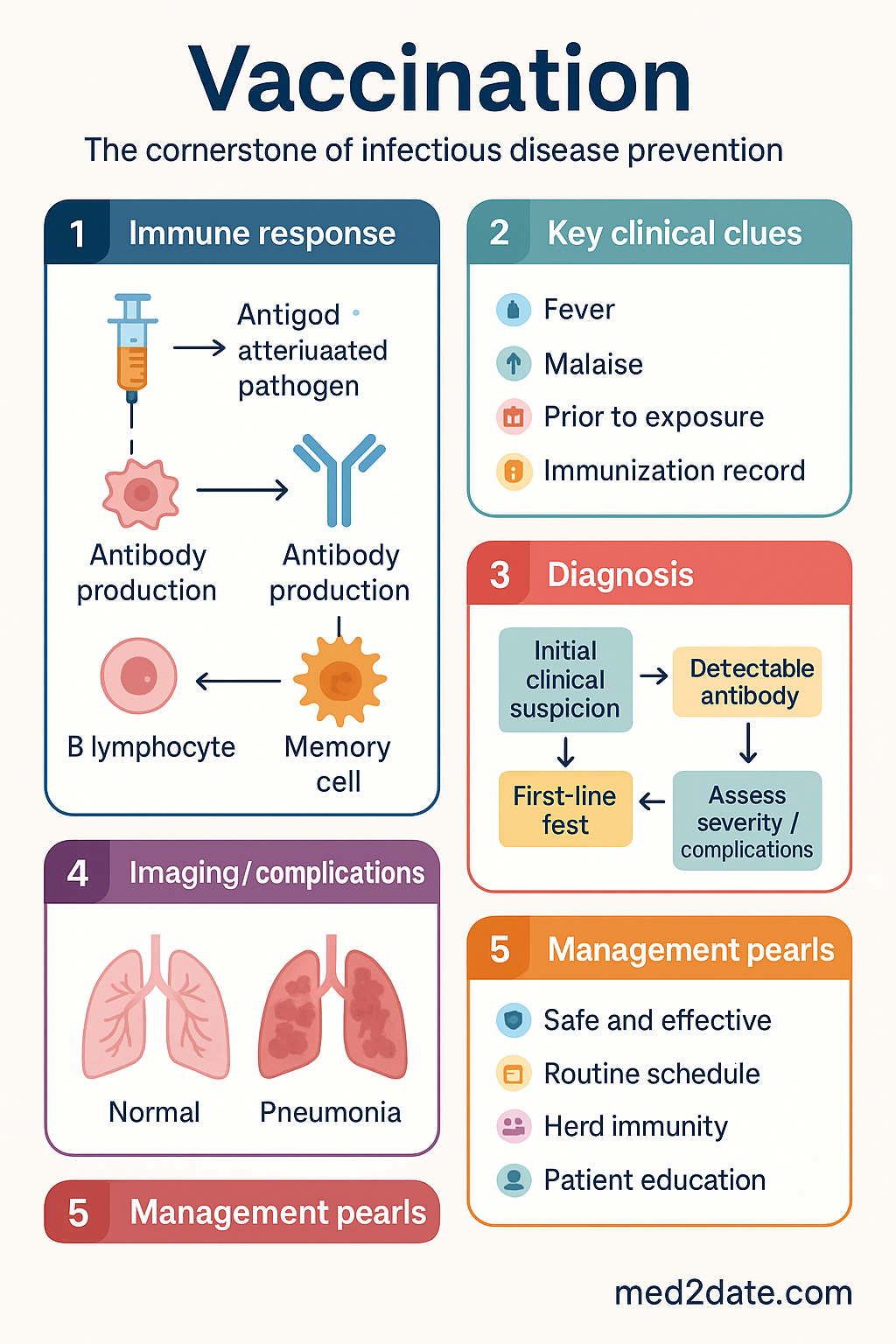
Vaccination protects by priming the adaptive immune system to respond rapidly and effectively upon subsequent pathogen exposure. This involves coordinated humoral and cellular immune responses that generate immunological memory — the cardinal goal of all vaccination.
Humoral Immunity (B-Cell / Antibody-Mediated)
- Primary response: Antigen presentation to B-cells in germinal centres of lymph nodes → clonal expansion → IgM production (days 5–10), followed by class switching to IgG (day 10–14+).
- Affinity maturation: Somatic hypermutation in germinal centres produces higher-affinity antibodies with each successive exposure.
- Memory B-cells: Long-lived cells (decades) that rapidly differentiate into antibody-secreting plasma cells upon re-exposure.
- Long-lived plasma cells: Reside in bone marrow; secrete antibodies continuously without re-exposure to antigen — basis for durable protection.
- Functional antibody mechanisms: Neutralisation (blocking pathogen entry), opsonisation (enhanced phagocytosis), complement activation, antibody-dependent cellular cytotoxicity (ADCC).
Cellular Immunity (T-Cell-Mediated)
- CD4+ helper T-cells: Th1 (intracellular pathogens), Th2 (extracellular pathogens/helminths), Tfh (germinal centre support for B-cells), Th17 (mucosal defence). Essential for coordinating both humoral and cellular responses.
- CD8+ cytotoxic T-lymphocytes (CTLs): Kill virus-infected cells via perforin/granzyme pathway; critical for clearance of intracellular pathogens (e.g., varicella, influenza).
- Central memory T-cells (Tcm): Reside in lymph nodes; rapidly expand upon re-encounter with antigen.
- Tissue-resident memory T-cells (Trm): Positioned at mucosal surfaces (respiratory tract, gut); provide frontline defence at the site of pathogen entry.
- Hepatitis B: Anti-HBs ≥10 IU/L (protective level); some experts recommend ≥100 IU/L for healthcare workers.
- Measles: Neutralising antibody titre ≥120 mIU/mL (varies by assay).
- Tetanus: Anti-tetanus toxoid IgG ≥0.1 IU/mL (basic protection); ≥1.0 IU/mL (full protection).
- Influenza: Haemagglutination inhibition (HAI) titre ≥1:40 (50% protective threshold).
Herd Immunity
When a sufficient proportion of a population is immune, the chain of transmission is interrupted, indirectly protecting unvaccinated individuals. The herd immunity threshold (HIT) is calculated as HIT = 1 − 1/R₀, where R₀ is the basic reproduction number.
| Disease | R₀ | Herd Immunity Threshold | Target Vaccine Coverage |
|---|---|---|---|
| Measles | 12–18 | 92–95% | ≥95% (2 doses MMR) |
| Pertussis | 12–17 | 92–94% | ≥92% (primary series + boosters) |
| Polio | 5–7 | 80–86% | ≥85% (IPV primary series) |
| Diphtheria | 6–7 | 83–86% | ≥90% (primary series + boosters) |
| Influenza | 2–3 | 50–67% | ≥75% (annual vaccination) |
| COVID-19 (Omicron) | 8–15 | 87–93% | High coverage reduces severity; sterilising immunity not achievable long-term |
Adjuvants
Adjuvants are substances added to vaccines to enhance, accelerate, and prolong the adaptive immune response. They are essential for subunit and recombinant vaccines, which lack the intrinsic immunostimulatory signals of whole-organism preparations.
Mechanisms of Action
- Depot formation: Aluminium salts create a local depot, slowly releasing antigen and prolonging immune exposure (days to weeks).
- Activation of innate immunity: Pattern recognition receptors (TLRs, NLRs, RIG-I) are activated by adjuvant components, triggering inflammatory cytokine production and dendritic cell maturation.
- Enhanced antigen presentation: Activated dendritic cells migrate to draining lymph nodes and more efficiently present antigen to T-cells.
- Biasing of T-cell responses: Different adjuvants can skew toward Th1 (cell-mediated), Th2 (humoral), or balanced responses.
Adjuvants Used in Australian Vaccines
| Adjuvant | Composition | Australian Vaccine(s) | Key Properties |
|---|---|---|---|
| Aluminium hydroxide / phosphate | Aluminium salts | Hepatitis B (Engerix-B), HPV (Gardasil 9), DTPa (Infanrix Hexa), Pneumococcal 13v (Prevenar 13) | Well-established safety profile (>90 years of use). Promotes Th2-biased responses. Injection-site reactions (pain, swelling) common. |
| AS01B | MPL (monophosphoryl lipid A, TLR4 agonist) + QS-21 (saponin) in liposomes | Shingrix (herpes zoster) | Very potent; induces strong CD4+ T-cell and antibody responses. >90% efficacy against shingles even in elderly ≥80 years. Higher reactogenicity (myalgia, fever). |
| AS04 | MPL adsorbed onto aluminium phosphate | Cervarix (HPV — older formulation, now superseded by Gardasil 9 on NIP) | TLR4 activation + depot effect. Strong antibody persistence (>11 years). Th1 + Th2 balanced response. |
| MF59 | Squalene oil-in-water emulsion | Fluad Quad (adjuvanted influenza for ≥65 years on NIP) | Enhances antibody response in elderly; improves cross-protection against drifted strains. Not associated with autoimmune disease. |
| CpG 1018 | Synthetic oligodeoxynucleotide (TLR9 agonist) | Heplisav-B (hepatitis B — 2-dose schedule, available privately) | Th1-biased response; higher seroprotection rates vs alum-adjuvanted hepatitis B vaccines. Allows 2-dose (0, 1 month) vs 3-dose schedule. |
Vaccine-Preventable Diseases
The following section covers the major vaccine-preventable diseases relevant to Australian clinical practice, with emphasis on epidemiology, vaccine type, NIP schedule, and clinical management.
Measles
Despite elimination status in Australia (achieved 2014), imported cases continue to cause outbreaks in under-vaccinated communities. Australia recorded 262 cases in 2023, predominantly linked to overseas travel.
- Vaccine: MMR (Priorix) — live attenuated; NIP at 12 months + 18 months (or MMRV at 18 months). Second dose at 4 years (catch-up).
- Efficacy: ~95% after one dose, ~99% after two doses.
- Herd immunity threshold: ≥95% — requires high two-dose coverage.
- Serological confirmation: Measles IgG positive (MBS item 69450). Non-immune healthcare workers require two documented MMR doses.
Influenza
Annual influenza vaccination is recommended for all Australians ≥6 months. NIP-funded for: ≥65 years, Aboriginal and Torres Strait Islander peoples ≥6 months, pregnant women, and individuals with specified medical risk factors.
Pneumococcal Disease
Streptococcus pneumoniae causes invasive pneumococcal disease (IPD), including bacteraemia, meningitis, and pneumonia. Australia has a significant burden in Aboriginal and Torres Strait Islander communities.
COVID-19
SARS-CoV-2 vaccination remains a cornerstone of pandemic management in Australia. ATAGI recommends an annual COVID-19 vaccine for all adults ≥75 years, with consideration for 65–74 years and younger adults with risk factors.
Pertussis (Whooping Cough)
Pertussis remains a significant cause of infant morbidity and mortality in Australia, with cyclical epidemics every 3–4 years. Maternal vaccination during pregnancy (20–32 weeks) is critical for neonatal protection.
Hepatitis B
Australia has maintained a universal infant hepatitis B vaccination programme since 2000. Adult vaccination targets high-risk groups, including healthcare workers, people who inject drugs, prisoners, and men who have sex with men.
Human Papillomavirus (HPV)
Australia is on track to become the first country to eliminate cervical cancer, largely due to the school-based HPV vaccination programme (since 2007) combined with the National Cervical Screening Programme.
Herpes Zoster (Shingles)
Herpes zoster affects approximately 1 in 3 people during their lifetime. The AS01B-adjuvanted recombinant vaccine (Shingrix) has replaced the live attenuated vaccine (Zostavax) on the NIP from November 2023.
Other Notifiable Vaccine-Preventable Diseases in Australia
| Disease | Vaccine (NIP) | Schedule | Notes |
|---|---|---|---|
| Diphtheria | DTPa (Infanrix Hexa), dTpa (Boostrix) | 2, 4, 6 months; 18 months; 4 years; 12–13 years; adult boosters q10y | Toxoid vaccine; booster essential for ongoing protection. |
| Tetanus | DTPa, dTpa | As per diphtheria schedule; post-exposure: unvaccinated = TIG + dT | Wound management: tetanus-prone wound in unvaccinated/partially vaccinated → TIG 250 IU IM + dT vaccine. |
| Polio | IPV (in Infanrix Hexa) | 2, 4, 6 months; booster at 4 years | Australia uses IPV only (no oral live vaccine). |
| Haemophilus influenzae type b (Hib) | Hib conjugate (in Infanrix Hexa, Act-HIB) | 2, 4, 6 months; booster at 12 months | Dramatic reduction in invasive Hib disease since programme introduced. |
| Meningococcal ACWY | Nimenrix (MenACWY) | 12 months (NIP); school-based at 12–13 years | Also covers MenB (Bexsero) for ATSI infants and high-risk groups (not routine NIP). |
| Rotavirus | Rotarix (live oral) | 2 months, 4 months (2-dose schedule) | Must be completed by 24 weeks 6 days (dose 1) and 32 weeks 6 days (dose 2) due to intussusception risk window. |
| Varicella (Chickenpox) | MMRV (Priorix-Tetra) or Varilrix | 18 months (MMRV); second dose catch-up at 4 years | Live vaccine; avoid in pregnancy. Two doses required for seroconversion in ~99%. |
| Hepatitis A | Havrix Junior / Havrix 1440 | ATSI children in NT, Qld, SA, WA: 12, 18 months | Inactivated; not routinely funded for non-ATSI children. |
Investigations
Serological testing plays an important role in confirming vaccine-induced immunity, particularly in high-risk groups. The following investigations are available in Australia through pathology services.
Risk Stratification & Priority Groups
Identifying patients at highest risk of vaccine-preventable disease or complications is essential for prioritising vaccination in general practice.
Pre-Travel Vaccination
Travellers should consult a travel medicine practitioner or GP at least 4–6 weeks before departure. Non-NIP travel vaccines (e.g., yellow fever, typhoid, Japanese encephalitis, rabies, cholera) are available through private prescription and travel medicine clinics.
Monitoring & Adverse Events
Post-Vaccination Monitoring
- Observation period: All patients should be observed for ≥15 minutes post-vaccination. Patients with history of anaphylaxis to any component: ≥30 minutes.
- Adrenaline availability: All vaccination sites must have adrenaline (epinephrine) 1:1000 available for anaphylaxis management, along with oxygen and basic airway equipment.
- Common expected reactions: Injection-site pain/redness (30–80%), low-grade fever (5–15%), malaise (10–30%) — typically resolve in 24–72 hours. Paracetamol or ibuprofen can be used for symptomatic relief.
Serious Adverse Events Following Immunisation (AEFI)
| AEFI | Vaccine(s) Associated | Estimated Frequency | Management |
|---|---|---|---|
| Anaphylaxis | All vaccines | ~1.3 per million doses | IM adrenaline (0.01 mg/kg, max 0.5 mg), call 000, observe ≥4 hours. |
| Febrile seizure | DTPa, MMR/MMRV, influenza | ~1 per 3,000 (MMRV dose 1); ~1 per 10,000 (DTPa) | Reassurance; does not contraindicate further doses. Differential diagnosis includes meningitis if clinically indicated. |
| Myocarditis/pericarditis | mRNA COVID-19 (Comirnaty, Spikevax) | 1–4 per 100,000 (higher in males 12–30 years) | ECG, troponin, echocardiogram. Cardiology referral. Most cases mild and self-limiting. |
| Thrombosis with thrombocytopenia (TTS) | Vaxzevria (AstraZeneca COVID-19) | ~1 per 50,000 (dose 1); ~1 per million (dose 2) | No longer in use in Australia. Platelets, D-dimer, PF4 antibody assay. Treat with non-heparin anticoagulation (IVIG). |
| Intussusception | Rotavirus (Rotarix) | ~1 per 50,000–100,000 doses (dose 1 risk window: 1–7 days) | Symptoms: sudden inconsolable crying, vomiting, bloody stool, lethargy. Urgent surgical review. |
| Vaccine-associated paralytic polio (VAPP) | Oral polio (not used in Australia since 2005) | ~1 per 2.4 million doses | Australia uses IPV exclusively — zero VAPP risk. |
Australian Immunisation Register (AIR)
The AIR (managed by Services Australia) is a national register that records all vaccines given to individuals of all ages. Clinicians must report all vaccinations to the AIR. Patients can view their immunisation history via myGov.
Special Populations
Aboriginal and Torres Strait Islander Health Considerations
📚 References
- 1. Australian Government Department of Health and Aged Care. Australian Immunisation Handbook. Canberra: Australian Government; 2024. Available from: https://immunisationhandbook.health.gov.au
- 2. Australian Technical Advisory Group on Immunisation (ATAGI). ATAGI recommendations on the use of COVID-19 vaccines. Canberra: Australian Government Department of Health and Aged Care; 2024.
- 3. National Centre for Immunisation Research and Surveillance (NCIRS). Annual Immunisation Coverage Report, 2023. Sydney: NCIRS, University of Sydney; 2024.
- 4. World Health Organization (WHO). Global Vaccine Action Plan 2011–2020: Review and lessons learned. Geneva: WHO; 2020.
- 5. Pollard AJ, Bijker EM. A guide to vaccinology: from basic principles to new understandings. Nature Reviews Immunology. 2021;21(2):83–100.
- 6. Australian Institute of Health and Welfare (AIHW). Aboriginal and Torres Strait Islander Health Performance Framework 2023: summary report. Canberra: AIHW; 2023.
- 7. Pittet LF, Curtis N. Adjuvants in vaccines: the search continues. The Lancet Infectious Diseases. 2023;23(5):e182–e185.
- 8. Weinberger B. Adjuvants for vaccines in the elderly — mechanisms and future perspectives. Vaccines. 2023;11(3):634.
- 9. Therapeutic Goods Administration (TGA). Database of Adverse Event Notifications (DAEN). Canberra: Australian Government; 2024. Available from: https://www.tga.gov.au
- 10. Nolan T, et al. Safety and immunogenicity of the AS01B-adjuvanted herpes zoster subunit vaccine in adults ≥50 years: a phase III randomised controlled trial. The Lancet. 2016;388(10056):2105–2116.
- 11. Dey A, Gidding HF, Menzies RI, et al. Australia's National Immunisation Program: coverage trends and implications. Medical Journal of Australia. 2024;220(4):198–204.
- 12. Polack FP, Thomas SJ, Kitchin N, et al. Safety and efficacy of the BNT162b2 mRNA COVID-19 vaccine. New England Journal of Medicine. 2020;383(27):2603–2615.
- 13. Australian Government Services Australia. Australian Immunisation Register (AIR). Canberra: Services Australia; 2024.